Monday, February 13, 2012

Alex, Tariq, JJ and Joydip

Minus 17°C and clear skies meant a cold morning guaranteed. The clear skies over the Rocher du Charvet were captured here in this early morning spectacle...


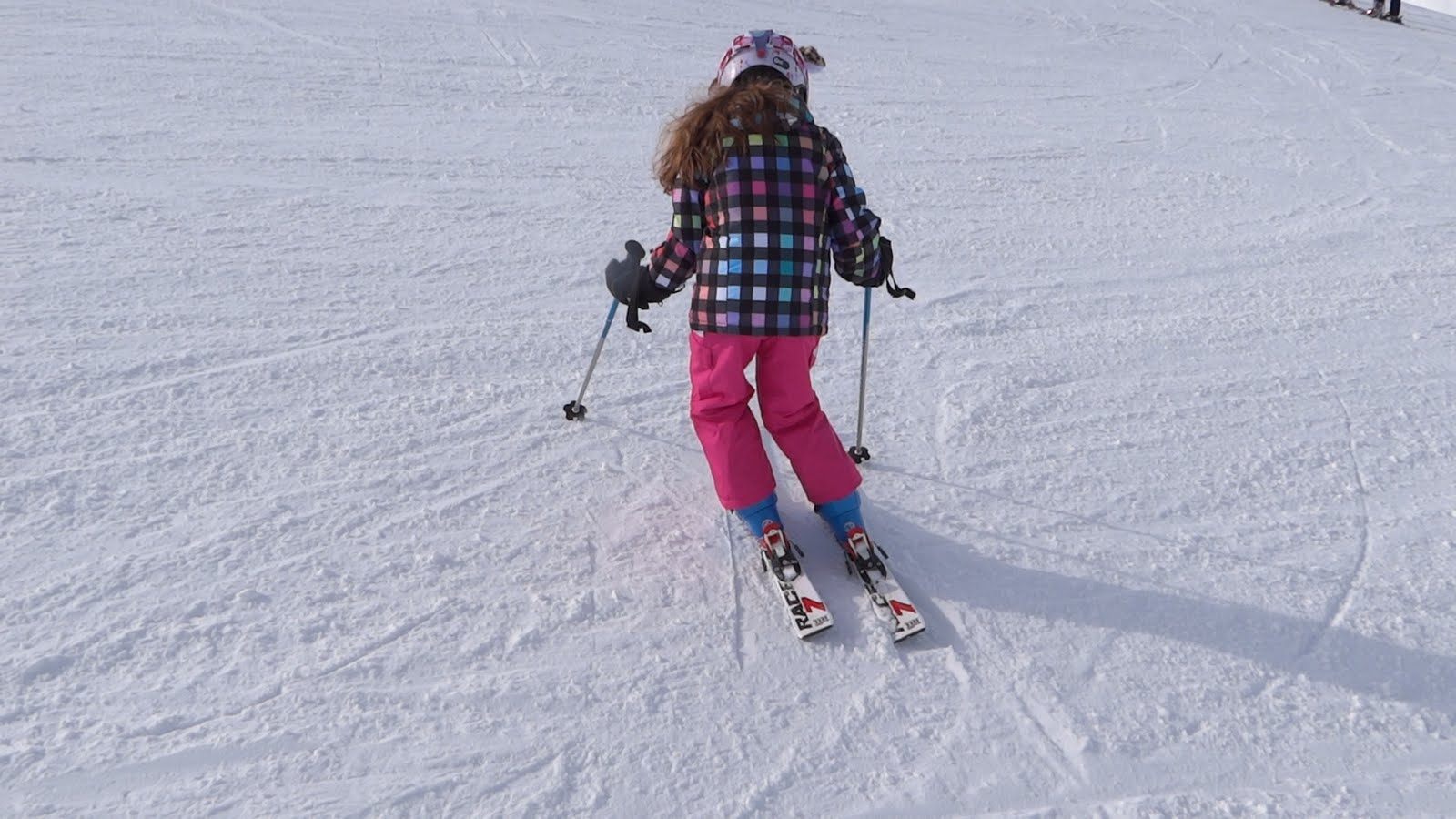
Tariq, Alex and JJ were quickly out the door in the morning and ready to ski - except that somebody had forgotten to give Alex skis - which upset him a bit. Never-the-less I offered him a piggyback lift all the way down from Legetaz to the Intersport shop in town to get his skis. This meant a rather disorganised start as the others had to follow regardless of their levels. Skis sorted out we then headed for the chairlift up the Face de Bellevarde because the queue for the main Olympique chairlift was enormous. This was again not ideal beause I didn't know how the weaker skiers would cope with the short connecting path across the face to the second lift up to the training area plateau. All went well though and we were soon up there and able to go for a warm up ski. It takes a run or two to get used to sliding after not being on skis for a year so it's best just to warm up by skiing for a while before trying to learn anything new.

Video of the boys skiing prior to changing anything...


Skating
Despite being at slightly different levels the boys were all able to ski on anything up to a red run standard - with JJ falling over frequently at this stage but compensating for that with a positive attitude. The first thing was to try to to get everyone skating. Correct muscular coordination for skiing is related to skating and so any exercises involving skating will help. Snowploughs use the opposite and wrong coordination so the idea is to replace ploughing with skating. Alex started off with slight problems on his first skating moves and immediately shook his head in despair because he couldn't do it. I told him straight that there was no pressure to get this immediately and certainly no reason to get upset or frustrated because skills can take a lot of work and practice to develop. You certainly don't give up and shake your head immediately when you can't do something - on the contrary, that's when you concentrate and get to work to change things. We skated around turns on very flat ground just to get the feel of it for the moment.

Dynamics
After a hot chocolate and warm up we went straight into dynamics. Prior to explaining anything we sideslipped down a steep section and I was really trying to use this as a means of training the boys to drop the snowplough stance. Placing the uphill ski into the snowplough position turns it into an unwanted accelerator - while in the parallel position close to the lower ski and beneath the body on the mountain it remains on it's upper edge and acts as a brake.

Not wanting to use physics to explain I described dynamics (Newton's second law) in terms of a "Magic Wall". Using an exercise where the skier pushes his shoulder against mine (where I substitute for the Magic Wall) the skier can feel the pressure on the appropriate foot when pushing against me. Pushing the right shoulder against me the pressure is on the left foot. Alex knew that to turn right he needed pressure on the left foot but when he tried to do this on his own he moved his body to the left - over the foot. This is also how Alex skied in the above video and how he would have been taught in ski school. I showed that pushing against my shoulder or the Magic Wall meant moving the body the opposite way - in the same direction as the turn. The Magic Wall is invisible and only appears when moving forwards - on each side of the skier. The more you believe in magic and the harder you push against one of the walls the more stable you become and you turn in that direction. Basically your job is to fall over - in the direction of the turn - and the ski will bring you back up. The ski is stronger than you and it generates this Magic Wall that will always defend you if you commit yourself to "falling over". To enhance the dynamics we had a run in a half pipe which the boys definitely enjoyed. Here in the half pipe the banking of the sides helps to encourage the "falling over".

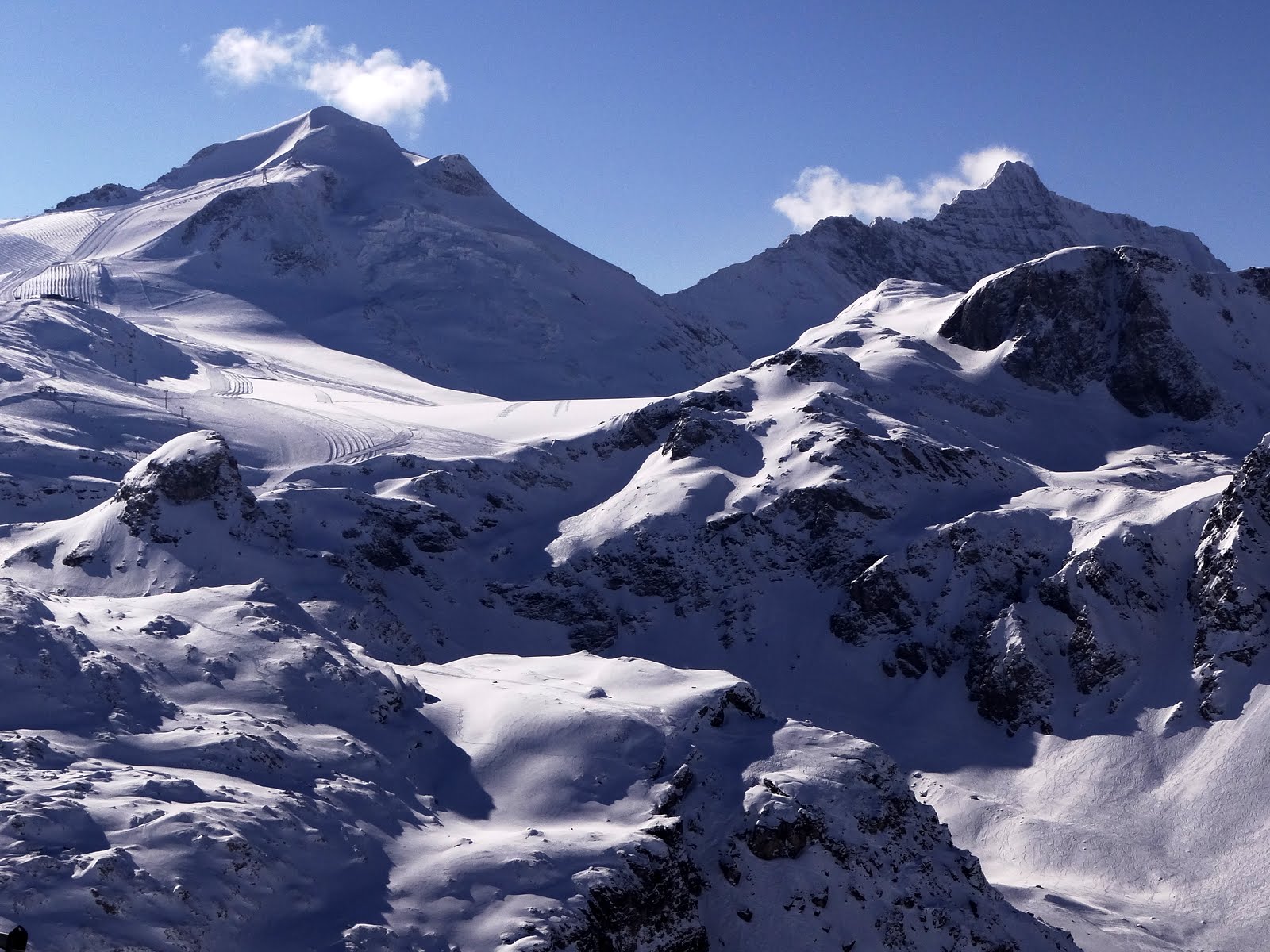
From the top of the Tovière (2695m altitude) we could see Mont Blanc which at 4810m is the highest mountain in Western Europe. Skiing down all the way to La Daille we were working on the Magic Wall and trying to reduce the tendency to snowplough. When working directly with dynamics increased speed actually helps so I was encouraging slightly higher speeds when possible. The boys were good at following my line which is set to encourage control of speed though turning instead of braking. Tariq was the strongest and most experienced skier but Alex probably learned and improved the most during the first session. JJ seemed to have a bit of trouble listening and with the brain/body connection - but that just means that I need to help him more in that direction for the time being.

Complete Beginner
Joydip had apparently tried skiing for one hour at some point in the past. I told him to forget that and we started at the very beginning. The start was delayed however because somebody had taken his skis by mistake so we had to go and get some more from the hire shop in town. This was a good choice to start from the beginning because it gave an opportunity to build up some fundamental skills which would otherwise not have come naturally to Joydip. Walking around on one ski at first Joydip fell over consistently when we tried to slide a little - but after about 20 minutes that stopped happening. The body adapts rapidly to accelerations if given a chance.


Skating was definitely alien to Joydip so we sidestepped up the hill - but at first the skis were still slipping away and despite identifying the edges of the feet and adductor muscles on the inside of the legs grip just wasn't there to be found. It dawned on me that each time joydip wanted to move he first placed his centre of mass directly over his foot and flattened his ski. He was trying to get the power of the leg instead of using gravity to just fall. This flattening of the ski caused it to slip away from him. When stepping or skating we have to grip with the edge and let the body fall to the side ( inside between the skis when skating). This is an interesting issue because the whole of skiing is just a development of this basic action. You can see in the video that Joydip eventually developed a good feel for this movement.

After climbing up the hill Joydip had to use the poles for a "bull fighter" turn and then straight run down the hill. Interestingly he was quite comfortable with straight running and didn't resist the accelerations. On his final descent I told him to just lean very slightly to the left and he would turn left and right to go right. This small motion of the centre of mass is enough to make the skis work - and he got it first time.


Sunday, February 12, 2012

Henri - Second Morning

Down to business today. Henri knew a good chunk of the theory and had a good grasp of the physical actions involved - but putting it together and making it work is another story.

Clip 1. Carving introduction
Clip 2. Improved dynamics - but still very static
Clip 3. Trying to be more aggressive but not getting there due to the piste being narrow - defensive and static
Clip 4. Breaking through - getting faster - natural down/up rhythm - better dynamics

Holism
Skiing does not resemble something mechanical like a car. Car mechanics are linear and predictable. If an important part of the car breaks then the car won't work at all. Skiing is holistic which means that it will work even when parts are missing or wrong and that it's not necessary to have everything functioning for it to work. This allows you improve progressively and to focus on one thing at a time - plus this removes any undue worry about not doing things as well as you would like to. Another aspect of this is that the final product is always rather complex and unpredictable - a bit like baking a cake with an unknown recipe - reflected in the fact that every human being is different. The final product is "more than the sum of the parts" and that is why it can never be completely explained directly in terms of parts. We can however, with experience, work out what parts to work on to bring around certain results - but more often than not the system reveals to us it's own solutions before we actually understand what the underlying problems really are. 

We went for a brief forage off piste to let Henri see that his dynamics would work there - and that it wasn't necessary to be perfect at it. Any improvement in dynamics will help and because the ski loads up like a trampoline in deeper snow - lifting you out of the turn prematurely if you are not aware of this - then this is a great way to improve and increase your dynamic range. You have to hold your centre of mass well inside the turn and try to err in that direction  - because the most common mistake is to be taken by surprise by the "lifting up" power of the ski and to get pitched out of the turn instead. Henri did well off piste for the first time.

Later on when Henri was struggling with increasing dynamics on the piste and I had to decide on a strategy I was confronted with this "holism" problem. Would Henri's rotation make increasing dynamics impossible or would my gut feeling that he just needed to be more aggressive work despite the rotation? Impossible to say. Given the limited time available I decided to push Henri to be much more aggressive - to REALLY try to fall down into the turns and not hold back - and to increase speed to help with generating forces. The great surprise was that when he did this - not only did it work very well, but the body rotation disappeared. That was an outcome that couldn't be predicted - it was unique. Normally rotation gets worse as a defensive reaction.

Exercises
Dynamics part 2
We worked through some of the skating exercises from yesterday after warming up. I wanted Henri to properly step up onto his uphill leg during the final skate in each turn - so that he would commit 100% to the leg (and hip) that he would be standing on for the next turn. This was to counter his tendency to crouch down onto two feet instead of stand up strongly on one leg. The up motion would come from the lower leg and then the dynamics executed while standing strongly on the upper leg. The fact that the upper ski was on the top edge is irrelevant. Turns can begin from either edge. With this skating step turn the push up is difficult because it is against gravity and the forces produced by the skis - so it has to be very deliberate. 

The next stage is to use the push up more dramatically - instead of going against gravity - going with it! I had Henri jumping up when on his uphill edges going across the hill and trying to land on his lower edges going into a new turn. This is an another way to make the legs active and coordinate the powerful up-lifting effect of the skis with the use of muscle power and appropriate movement of the centre of mass.

The reason for these exercises is to develop the last part of the turn where the body has to come back up out of the turn (think motorbike). When making flowing turns with forward motion the turn transition (from one turn to another) requires that the skier goes through a phase where the body is perpendicular to the slope with the skis flat on the surface and sliding across the hill. This actually means coming up and almost right over into the next turn on the lower ski. In racing a large percentage of turns are actually started on the lower ski.

Getting the turn completion correct guarantees a good start to the next turn - but it can be scary to commit to that degree at first - until you know that it makes you bomb proof!

Carving
Henri really needed to increase his confidence moving at higher speeds and nothing is better for this than learning to carve. Once a skier can hold a ski carving on it's edge then the feedback received is much more solid and clearer - plus the accelerations (linear and angular) are a whole magnitude greater. This accelerates learning because the number one key to learning is feedback.

Henri got the idea of standing on two edges, rocking his feet and moving his centre of mass over the inside ski (and weight when static). He had some resistance to letting the skis run along their arc and in the video you can see that once there is some speed the skis are allowed to fall off the edges - not so much for pivoting but more for braking purposes. Henri did get the basics and understood the goals plus he did become faster. This has to be done on relatively gentle and wide, empty slopes.

Dynamics Resistance
There wasn't a lot of time to get a result with Henri and his inexperience of sliding sports meant that he needs time to adapt. I could see that his attitude on skis was defensive - controlling speed through braking rather than pure turning and choice of line. This defensive strategy is learned. To try to provoke a rapid change I explained to Henri that skiing is all about accelerations - about really trying to fall over - about speed. This is what brings it all to life and counter intuitively this is what generates real security and control. Henri had understood the theory of dynamics yesterday - but not the spirit of it. It was time to change that. When Henri really tried to fall over and accept the speed - then the magic started to happen. The last clip in the video sequence shows a very natural timing - which "happened to" Henri - instead of him trying to make it happen. He looks like he is skating and the turn transitions are good - this is no accident. Henri was starting to replace his braking strategy with dynamics and starting to ski.

Running
There wasn't time to work on upper/lower body separation and on how the hips move and spine twists - all protected by the active core muscles. Likewise there wasn't time to work on Henri's desire to improve his running capacity. The following link ( Ed Pirie ) is a free pdf format ebook written by one of the greatest runners in history - and he gives some very good technical information. More important information still can be found in the book "ChiRunning" by Danny Dryer (search on Amazon). Dryer in my opinion is extremely insightful and accurate. It should be relatively easy to make the changes advocated by Dryer when young - and could make the difference between a sporting future that lasts a lifetime or one that terminates early though chronic wear and tear injuries through poor mechanics. Speed is just a side benefit!

Saturday, February 11, 2012

Henri - First Morning

Initial Assessment
Herni has a little experience of skiing but has only been taught ineffective standard concepts. Henri's stance was comfortable and generally perpendicular with the mountain and not relying on his ski boots for support - showing that he had no negative issues regarding dealing with accelerations. The weighting of the outside ski in the turn was causing him to try to move the Centre of Mass in the wrong direction (correct direction as far as his previous teachers were concerned.) This would cause him to skid sideways at speed and to worry about catching the inside ski on something. In addition he was tensing his feet and pushing against the outside sidewall of the boot in order to throw his skis sideways - effectively standing on the wrong edge of his support foot. The overall effect was to make him rapidly very physically tired.

Mont Blanc in the background.

The video shows Henri skiing first of all without changing anything - then with some tentative dynamics added (in the right direction) and finally with some skating step turns.


Dynamics
The session began immediately with an explanation of dynamics and a few standard static exercises. Herni was given an explanation of statics and dynamics - separate branches of mechanics. Standing statically the way to get the weight over any foot is to move the centre of mass above the foot. This is how "pressurising" the ski or "transferring weight" is normally taught in skiing - but it is wrong. Henri pushed against my shoulder with his shoulder to the right so that he could feel pressure on his left foot - then he accelerated his body across a gap (on the right) - against my shoulder so that he could feel the pressure from the acceleration and then sustain it when against me. My body just substitutes the forces from sustained angular accelerations provided by the ski once moving forward. Repeating the exercise slowly moving to the right to bridge the gap Henri could feel the weight then going onto the right foot as the centre of mass passed above it. This difference in effect between static (or constant) motion and acceleration has to be understood very clearly. Skiing requires us to work with accelerations. After a few exercises using dynamics when sliding diagonally downhill and creating turns uphill to stop, we rapidly moved into complete turns and then linked them together. I explained the mechanics with crude reference to Newton's laws - more information on which can be found by searching within the pages of the blog.

Henri immediately felt much less tiredness and stress on his legs than he normally felt when turning. The dynamics were allowing his body to function more efficiently already.

The Feet
Henri mentioned that his feet were very tense - from a grasping action inside the ski boots. We went indoors to work with the feet and stance correctly. I removed both boots so that my feet could be seen but Henri only needed to remove one. I showed how standing on the whole foot can lead to a collapsing of the ankle during flexion and a vulnerable twisting of the knees from side to side if they were forced sideways. The simplest way to make the feet and ankles strong is to stand on the heels and then flex only the knees and hips. This activates the anterior tibialis muscle in front of the shin and makes the ankle strong and supportive. Many people lean on the ski boot for support but this is wrong - the leg only should support you - the boot is only to help you to maintain your stance and push you back into place. Henri was shown how the subtaler joint beneath the ankle permits the foot to be rocked - and how this is accessed by standing on the heel. Holding the toes up also helps to counter the tendency to curl them downwards in a grasping/grabbing action. Rocking both feet to the right the centre of mass also displaces to the right - connecting the centre of mass to the feet - the feet also represent the edges of the skis. The leg of the foot on it's inside edge experiences a tightening of the adductor muscles (skating muscles) on the inside of the leg. Going outdoors we immediately employed the rocking of the feet on a gentle gradient. Herni had no problem integrating the action of the feet.

Combing the Feet and Dynamics
Next stage was to combine the rocking of the feet inside the ski boots, with the dynamics - all working towards the centre of the turn. This was tricky for Henri as he has already developed the habit of doing the opposite of all of those things. I explained how it is a natural emotional response to want to stay upright and to throw the skis outwards - an inappropriate emotional response unfortunately reinforced by his original teaching. Additionally this tendency is reinforced by the illusion of "centrifugal" force throwing you out of the turn  - a force which simply does not exist. Henri now had to make himself challenge all of those things and work in a very counter intuitive manner instead. Everything moves "inwards" towards the centre. While most people are desperately trying to remain upright on skis the aim of the skier should be to fall over - laterally. Bicycles work on the same principle - when the centre of mass falls over the bike responds by changing shape and undercutting the trajectory to bring the cyclist back up. Skis do the same. Bikes lose grip when they go over too far - but a skier's grip increases exponentially as the edges bite. The real problem for a skier is increasing the range of falling because the skis are so powerful that the prevent the skier from getting very far over. In essence the skier's job is to fall over and the ski's job is to bring the skier back upright. The ski is the stronger partner - much to the complete surprise of most people.

Skating
Henri was able to skate correctly so we worked a little at being able to skate across a hill - getting onto both uphill edges. It was a bit tough for Henri to start turns with a skate - except on very flat terrain - but this is normal to begin with. We progressively worked downwards from three skates to two and eventually one during the turn. The aim is to move the centre of mass always inwards and to develop the use of the skating muscles and independence of the legs. Skiing is essentially a one legged activity. Henri has previously learned to rush the start of his turns to get the skis around and below him - this being completely inappropriate. It's hard to switch from that to skating and taking time over the start of a turn. Eventually speed should be controlled through choice of "line" and direction - not through braking. Completing any single turn leads ultimately to a stop.

Timing
Skating has a rhythm and timing. The rhythm is obviously leg to leg - but less obviously this has to be made to last longer on each leg to come into resonance with the skis. Dynamics - itself generates timing. Picture a motorbike dropping down into a turn and coming back up out of it  - the centre of mass goes down and up - it has to. Skiing is exactly the same in this respect and the connecting of turns creates a stabilising rhythm. Slalom courses are set out to specific rules so that rhythms are maintained and broken to strictly determined patterns.

Combining Skating with Dynamics
Henry was able to start to identify the sense of rhythm and timing from combining the skating with dynamics - falling actively to the inside of each skating stride. This is hard to do at first but we worked up to it progressively. I asked Henri to skate aggressively and in an accelerating manner directly downhill (shallow gradient) and then to do one turn to stop with dynamics. Skating aggressively was necessary to prevent the tendency to unconsciously go defensive and push the tail of the ski outwards in a braking action. Eventually Henri was able to stay with the skating and dynamics together well enough to feel the rhythm.

Pivot
To finish with we started to look at pivoting from the uphill edge of the uphill ski. I wanted Henri to realise that inside edge - from snowplough to racing - was NOT what skiing is all about. I supported Henri through his first pivot and then he straight away learned to use pole support - lifting his lower ski off the ground and and using the pole planed directly downhill from his heels to support his weight and prevent the ski from flipping onto the inside edge too soon. This is difficult because it requires pulling the ski sideways with the adductor muscles into the turn - and this is the opposite of pushing it outwards - which Henri is used to doing. I demonstrated to Henri the effectiveness of this sort of pivot and he was able to see the difference between this and "pushing out". Henri was shown how to use the lateral support of the boot to stand on his uphill ski on the uphill edge and let the foot inside the boot rock onto its inside edge - without the ski changing edge. This allows the adductor muscles to work and for the ski to slip into the turn more easily. This type of turning is how bumps, couloirs and any direct fall line skiing are all tackled - keeping the skis below the body on the mountain at all times for security and always skiing on uphill edges. The moment of edge change is when the skis are facing straight downhill.  In racing and turning on the inside edge the moment of edge change is during the turn transition when the skis are more or less across the hill.


Friday, February 10, 2012

Pro Development

K2 Kung Fujas
Today was a day for getting used to new skis and working on technique. Fed up with trying to work with ski manufacturers and small minded shop keepers I just decided to go out a buy skis and free myself up from any commercial ties. My choice was encouraged by finding some excellent skis on sale and I ended up with the K2 Kung Fujas 179cm. This is a twin tip ski - almost as wide at the back as the front - and 102mm wide beneath the foot. It has a double rocker set up. I'd tried the wider Zag version  - the H112 - and found it to be horrible - but the reviews for this K2 ski were universally excellent (Freeskier Magazine) I'd liked the off-piste performance of the H112 so figured that a narrower and lighter ski of similar design might work out well as a good all rounder - and this turned out to be correct. 

The skis felt good immediately and only got better as I grew to understand them. Pivoting is incredibly effective - on piste. They are smooth in pivoting but grip well on ice at the same time. The ski is not so wide underfoot that it causes problems. Add another centimetre (H112) and the width makes piste skiing very unpleasant due to the ski levering the boot against the inside of the leg. The ski gripped well in a steep icy couloir - no trampoline-ing as happens with parabolic skis on steeps.  Likewise on the steep icy and dangerous terrain the ski was light enough for swinging into jump turns without any negative issues. On steep, icy bumps the double rocker made the skis feel creamy smooth - once I remembered to do compression turns! In deep snow with a thick - non supporting crust - they gave the confidence to turn without jumping after settling into a rhythm. In carving on the piste I found that the width threw me a bit and limited my dynamic range for the moment - but on the only occasion that I pushed this issue I was pinged twice into the air on turn completion because the skis are so lively and reactive. Once I get used to the skis in a few days time I'll be able to test this aspect out more thoroughly. The turn radius is longer than the Zag Big but I'm not sure this will remain the case once I'm more comfortable with them. 
Overall a fantastic ski and with the packaged tough Marker Griffon 13 binding amazing value on sale through Intersport at 489€ altogether. Now I'm floating around inside my ski boots with the skis being so resposive so I can see another purchase on the horizon already.

The video here is on steep off-piste (which is why the ski bases are visible) and I'm checking out the skis as well as a few technical issues with hip alignment. Gareth was doing his best to render the Sony optical stabiliser ineffective...


Hip Alignment
Gareth has been dogged by a technical issue that is very common - that of "leaving the foot behind" and blocking or resisting at the hip joint. This then has knock-on effects involving arm carriage and rotation. No amount of trying to push the foot forward would appear to cure this - in fact it left him with very badly bruised calf muscles.


Isolating the hip and pulling it backwards - instead of pushing the foot forwards - appears to be the answer to this issue. In the video above this is what Gareth is focusing on and it is clearly working for short turns - he is staying very well centered over his feet and not "leaving the foot behind". The only change made was to pull the hip backwards. This solution is derived from studying the body mechanics of correct walking and running - then adapting them to both cycling and skiing. The muscles in the leg right down to the sole of the foot are all aligned differently and there is much less strain taken up by the quadriceps. I'm practising the same thing in the top video and it permits me to be very flexed without that causing muscular tiredness. I'm not "fall line" skiing, the turns are more rounded but the principle remains the same. The hips are re-aligned during the turn transition. Normally in short turns upper-lower body separation is considered to "wind up" the body with the spine twisting in a counter direction to the turn - shoulders facing downhill. This actually causes the (outside) hip to advance forwards relative to the shoulders. What we are doing here is the opposite - pulling the hip backwards during the turn, but allowing the shoulders to follow the turn - so the twist in the spine is now in the same direction as the turn. This tightens up the core muscles and protects the spine - plus permits a much greater level of athletic activity in general. The difference is very difficult to spot visually. What is clear is that the "foot left behind" issue is not a "cause" it is an "effect" of the hip moving in the wrong direction.


Thursday, February 9, 2012

Tignes Turkish Ski Championship

The sole criterion for the order of results is dynamic range.

No 1. Mete
Looking like a champ - except he is about to slide rather a long way sideways and down below the gate! He is definitely generating the biggest dynamic range here but his timing was a bit late due to inexperience and and the fact that it takes a while to learn how to generate "early" dynamics. Most people are "late" because they wait to react to supportive forces from the skis and the ground generated though angular accelerations and gravity - instead of generating them by launching the body downwards towards the snow - downhill - prior to there being any reactive forces already working. Also lacking in hip angulation and a bit collapsed at the waist - to be worked on... No shortage of determination!


No 2. Haluk
Not carving but surviving off-piste - same thing really. Good dynamics and arm carriage. What can't be seen here is the rotation at the start and end of the turn - which makes life relatively difficult - both off-piste and in slalom gates. Great dynamic range is not the only tool available for tackling off-piste - although it is the only way to "freeride". 


No 3. Defné
Looking strong with a generous dynamic range. Good arm carriage. She looks to be a little too far back in the ski boot and lacking in freedom around the hip - there being also a slight knee tuck. The main thing though is dynamic range and there is plenty of it here. This will allow Defne to ski well off piste and to use a slalom course to really develop her skiing to another level if she chooses to do so.


No 4. Emir
Emir is very clean on his edges and is well placed over his feet and relaxed at the hips. His poor arm carriage comes from the fact that he is not generating dynamics by moving his body - the dynamics are almost completely reactive - just responding to the skis on their edges and allowing the skis to to pass under the body from side to side. More time in the slalom course would sort that out.


Nos 5 & 6 Cagatay and Taha
Neck and neck in the dual slalom - and they look like clones too! Stiff outside legs and no hip angulation. Plenty of determination though. The dynamic range is not quite there yet but they both probably feel like they are right down at the ground. It was on this run I think that Taha really started to perceive the "Centre of Mass" and the role that it plays in dynamics and hence in skiing.


No 7 Derin
Definitely the cutest of the bunch - but let's see a little bit more dynamic range please!


Mete showing how dynamics works even on the "wrong" ski - if you commit your Centre of Mass in the right direction (and in this case have good awareness and control over your use of the skis edges). Mete knows that he had to move his body into the turn before changing edge and allow the ski to pivot from the uphill edge. Not bad for someone who has skied for a total of 3 weeks.


Monday, February 6, 2012

Haluk Off Piste

This morning began with a gorgeous sunrise in Tignes...


The force of this slab of snow that slipped down the mountain can be seen in the way it has ploughed the earth in front of it... 


There wasn't a lot of easily accessible deep snow around but as Haluk likes technically challenging challenging snow and steep slopes we were able to find some interesting stuff without resorting to hiking or any other time and energy wasting distractions...


Technical
Haluk is very aware of his technical limitations off-piste - both in heavy variable snow like this here and on ice. The main issue is lack of hip angulation. There are many observable symptoms in the performance but they shouldn't be allowed to mask and confuse "cause" and "effect". The underlying cause is a stiffness and resistance at the hip (outside of turn) due to it mechanically moving in the wrong direction (forward instead of backward) during the turn. Major symptoms include lack of angulation, over flexing of the ankles, under flexing of the hip, rotation of the upper body, over reliance on big dynamics and "inside edge" turn initiation. On ice this leads to the ski juddering and ineffective grip in the second half of the turn because the Centre of Mass is too far towards the exterior of the turn. Agility is also greatly affected.  Hopefully we will have the opportunity to start to work on correcting all of this soon. Just one central issue - awareness of the roll of the hip joint - can change all of the above.

Sunday, February 5, 2012

Derin, Defne, Emir

Asking Derin what she had learned during the past few weeks in the private ski school misleadingly named "Ecole de Ski Français" the answer was "To use the poles and put the weight on the downhill ski". Now look at the video and spot the pole plant! 


Derin has picked up a few things from the ESF - all of them detrimental to her skiing and body so I will list them all here first. 

1. Her previously good natural timing has been reversed. In the short turns she comes up to start the turn. She should be coming down to start the turn and was previously doing so.
2. When in the air she is pushing her skis outwards and sideways to get them below her. Previously she was getting early pressure on the outside (uphill) ski at the start of the turn because of her natural timing. Pushing the ski outwards is a major fault and incorrect coordination for skiing in general - she was not doing this previously.
3. She has no pole use whatsoever.
4. The body posture is completely inappropriate for any pole use and correct development of control.
5. She falls back against the back of her boots because the timing she was taught is wrong and unnatural so she looks for security against the boots instead of pressure under the feet. The acceleration downhill at the start of a turn is incompatible with an upwards projection of the centre of mass.
6. She is trying to compensate for the loss of control by forcing her knee into the turn - and sometimes collapsing the ankle in the process. This has probably been taught to her as well. It puts her at risk of a broken anterior cruciate ligament.
7. The incorrect timing can provoke long term lower back injury.
8. The short turns are initiated on the wrong edges - the inside edges instead of the outside uphill edges.

This is only a portion of the observable issues so on the mountain we moved straight on to addressing the most critical ones.

Timing
Derin remembered our previous lesson from a few weeks ago about the Centre of Mass - but she didn't really understand what it was all about. I explained about a bicycle because Derin likes riding a bicycle. The bicycle has to fall over into a turn and so comes down at the start of the turn and back up to finish. Bicycles and skis both do the same job. In fact on skis you can try to fall over to the side as hard as you can and the ski will always be stronger than you and bring you back up. This means that you go down to start a turn and up to finish one. The Centre of Mass has to be made to make this movement pattern because it drives everything.  We didn't have time for exercises but I wanted Derin to start to think in the right direction. Perception of Centre of Mass is a long term development issue and does not happen in one complete revelation overnight.

Carving
We looked at Derin's carving because she was standing only on one edge with the knee over the outside ski exposed to danger. The video above was taken after working on trying to stand on two edges. At very low speed the skis can be placed on the two left or two right edges and the Centre of Mass balanced between the two or even over the inside leg. When moving forwards the skis generate a strong angular acceleration and place the pressure automatically entirely on the outside ski - this being a result of dynamics. Derin was able to do the exercises and start to become aware of her edges and stance in carving and the use of her Centre of Mass - but her knees and feet were not supporting her correctly - especially with a strong tendency to try to edge the outside ski with the knee. This is dangerous and has obviously been taught to her - it is a very common feature of French ski instruction. We then had to go inside to both warm up (it was extremely cold) and do some exercises to understand how to use the feet and legs properly.


Magic Spots
Derin removed one ski boot and we looked at how to stand strongly on the foot so that the ankle wouldn't collapse. Initially this means standing on the heel. Derin now bent correctly at the knees and hips. From this position we worked on rolling the feet from edge to edge - which cannot be done on flattened feet. She felt how standing as she was previously only the knees moved from side to side, twisting dangerously. Now I helped her to feel the "magic spot" under the foot, just in front of the heel. This was easy because we discovered that it's very ticklish. If you stand on that spot then you can easily keep your shin in contact with the front of the boot - which she was able to feel with the other leg which still had the boot on. This is another "magic spot" on the shin. When you can stay on the two magic spots when skiing then you are able to generate the best control over your body and skiing. When leaving the café we carved by rocking the feet and locating the magic spots. We then returned back to Tignes focusing on magic spots all the way back. Rolling the feet in the direction of the turn helps to prevent the "pushing outwards" and starts to develop the correct coordination.


Defne is certainly skiing faster and this is probably a result of her discovering how to carve. Her short turns had similar coordination to Derin's though there was a light use of the poles and no vertical movement. I'm not going to make another list of issues here so will just recount the work that we covered. Emir was skiing strongly too but his carving was also better than his short turns. For the above reasons I chose to work on pivoting and short turns.

Hand Carriage
Defne had picked up the habit of skiing with her hands practically in her pockets. I had been informed from the Slalom Stade that her previous instructor also skied this way in front of her. There is nothing worse for causing a skier to lean back against the ski boots than developing the habit of skiing with the hands dropped and back. Emir was doing a bit of the same so I got them both to hold their poles like a bar in front of the body and ski holding them up. I explained how bad a poor arm carriage was and how you cannot do any sport - tennis, goal keeping - anything with your arms held like they were doing previously. This would be a prelude to learning correct use of ski poles later on.

Pivoting
Despite having successfully having taught Defne pivoting twice before it was completely erased from her memory. This is what happens with coaching and why good athletes sack bad coaches - whatever you are being trained to do will override anything you did in the past. Defne actually thought that you had to start all turns on the inside (of the turn) edges of the skis. We started by pivoting on the uphill ski and then did some on the downhill ski. I showed how it can be done on both skis as a single platform below the body on the mountian for security on steep terrain. Emphasis was made on strong use of the pole for support to move the Centre of Mass downhill without changing the edges of the skis. Emir was better at pivoting on the lower ski than Defne. This is due to Defne's need to develop better posture and angulation - but there was not enough time for that today. We did some short turns again and Defne showed a very strong improvement and was clearly managing to integrate the pivoting instead of pushing outwards as she was in the video. She used to be able to do this anyway about a year ago so there may be some unconscious body memory helping along here.

Bumps 
On the final run home we went off-piste on a steep bumps run where I could show the value of good pivoting. Most skiing is about pivoting and turn initiation on the uphill edges. Emir relished the challenge of the bumps and his better posture and control over the pivot meant that he had no problems. Defne was reluctant to experiment on the steep bumps - even slowly and in controlled steps. More work on posture, angulation, pole support and pivoting skill will make the transition to bumps and off-piste much easier for her. This will also give her much more success in slalom when the same properties are applied to carving. (Note: Poles are not used as a support in slalom.)

Friday, February 3, 2012

Taha Day 11

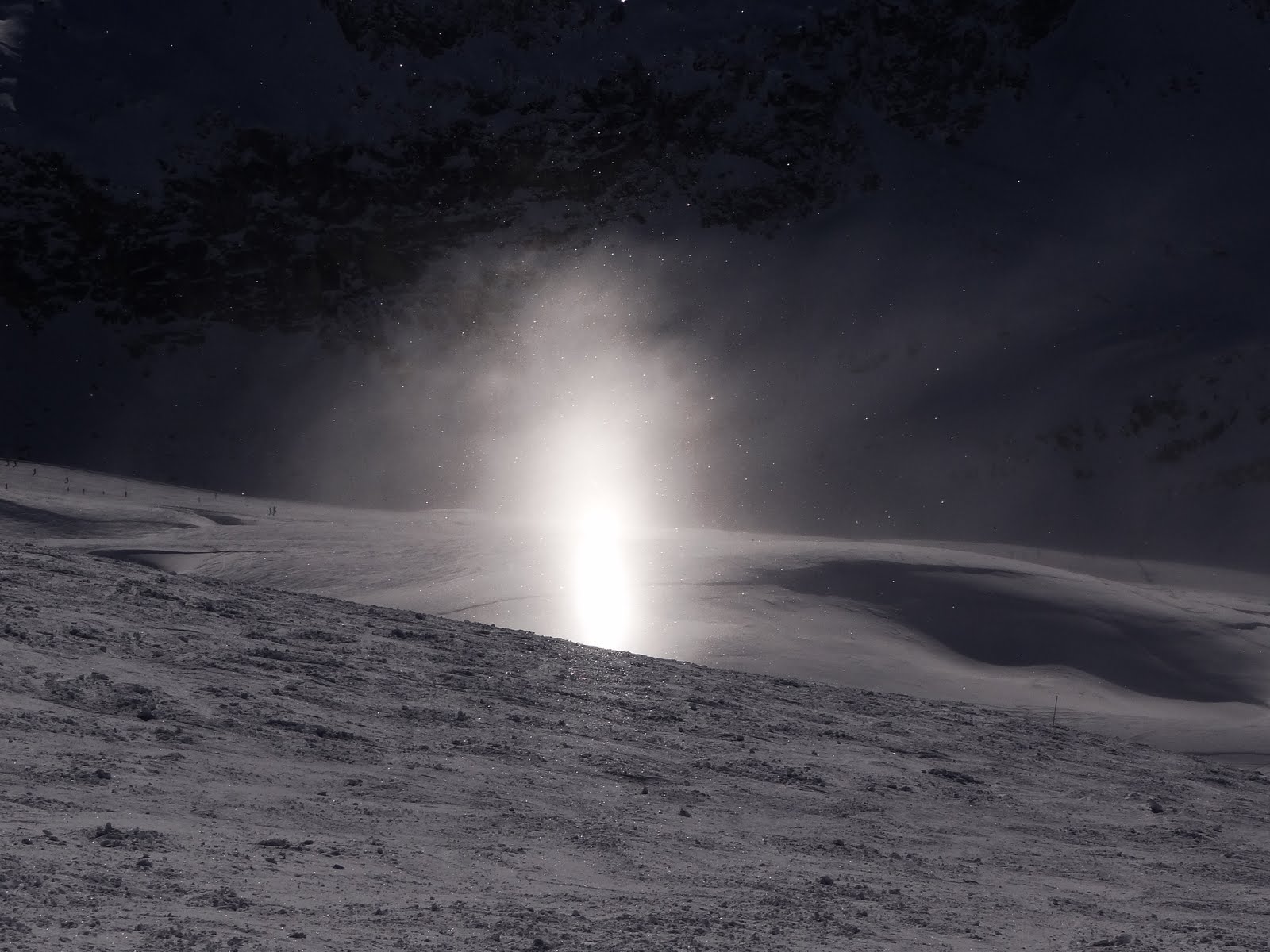
Final Day - coldest yet - but the sky was clear so the sun was able to keep us comfortable. Using the camera with thick gloves on was a bit tricky so the video is not as well filmed as usual. There was a "temperature inversion" with the cold weather front and so with the cold air low down in the valley there was a sea of cloud all day. It was snowing lightly in the valley all day. You can see the ice crystals floating in the air and some of the effects of the sun on the airborne ice in the photographs.


Slalom Competition
No new technique today - being the last day. It was time to put it all to use. We warmed up with light skiing and then a little carving and "racing skating"  prior to starting the slalom competition finals. 


Mete was the one to beat in slalom and in a Dual Slalom race Cagatay blew him away with a new famiy record of 33.65 seconds - the first ever to go under 34 seconds. This feat is extraordinary when you consider that Cagatay was snowploughing down the course only a week ago. Mete responded soon afterwards with a new record of 33.24 seconds and took the lead back again. Meanwhile Taha was improving and came very close with 34.18 finishing up with less than one second separating first from last place. In the end Mete won.


Mete had been working at increasing dynamics but by trying to lower his bottom into the turn instead of his shoulders. He was managing to improve this but the timing was still too late to get the most out of it. If he had improved his timing and line then he could have kept up his speed instead of losing it. 

Cagatay was trying to use his centre of mass more and was clearly attacking the course. He was still bending at the waist and keeping his leg too straight and stiff - instead of bending at the hips and knees. He had a very fast run close to the end of the competition but fell when his ski came off - but that was due to the stiff leg. 

Taha had a breakthrough with his understanding of dynamics and motion of the centre of mass on his last and fastest run. Although he had understood the theory it was only now that his perception properly caught up and he really "understood" it and felt it. 


Gulsum progressively recovered her confidence  after being traumatised yesterday and she finished up skiing again with a higher speed. One consequence of the higher speed is that it gives a sense of rhythm which brings along with it a stronger stability. It was good for Gulsum to finish on a good note and skiing strongly again. I kept on calling out to her when skiing to get her to look up instead of at the ground near her feet. Over time she started to focus more on what her body was doing - so the emotional impulse do do a "snowplough" was gradually replaced by more effective movements.


Thursday, February 2, 2012

Taha Day 10

Really COLD! No way I was taking photographs today.


Racing Skating
We started out very positively with a revision of Racing Skating so that Taha could understand the lesson he missed out on yesterday. Everyone managed to skate in the fall line quite well. Cagatay was still bending too much at the waist so I spent some time trying to get him to understand the difference between bending at the waist and bending at the hips. Gulsum definitely rotated less when skating. I pointed out briefly that the skate can also be done on the uphill edge of the outside ski - keeping the ski below the body on the mountain - just like in the pivoted fall line skiing.

Slalom
Due to the cold we went directly to the slalom  and Gulsum had no trouble skiing on the groomed slopes of the training piste - her first ever time on a black run. While she continued doing circuits on her own the boys went straight into the slalom. It was difficult keeping tabs on who was ahead because the time margins were so close. 

0.7 seconds separating first and last!

Taha managed the fastest time of the day to re-take his lead (only the most recent day counts) as fastest racer. But Catagay was only two tenths of a second behind Mete for third place. Chatagay is making determined progress now so Mete will have to make a big effort on the final day tomorrow. 

Taha's skiing is much more secure.  There is more flexibility, less rotation, more movement and generally a good overall function. All of this just needs to be exaggerated more with more dynamics added. Cagatay is being hampered by his bending at the waist and his skis often skid and lose grip and speed because the leg is straight and stiff. Mete tends to rotate his upper body into the turn when he moves his centre of mass into the turn. His rotation is mainly in the last half of the turn when fighting against gravity - his shoulders go into the turn and his hips go out and so the skis lose grip. I physically held Mete in positions for attacking the start of the turn and the end of the turn. The start being done with the body launching itself face first downhill  (I held him and brought his upper body towards me to give the feeling of falling downhill face first). For the end of the turn I held from behind under the arm pits -  lowering him until his bottom was close to the snow - simulating angulation through the end of a turn. 

We also discussed timing and how the apex of the turn needed to be brought from beneath the gate to beside the gate - and how you could imagine a trampoline at the outside of each pole that you would bounce off to cross back over to the other side. When we have higher speeds gravity is no longer the greatest force to deal with so the apex of the turn is no longer directly below the gate.

Carving
After slalom I filmed the boys carving on a wide piste - trying to increase their dynamic range and get closer to the snow with the centre of mass. Gulsum made a good effort too but Taha had his skis drifting sideways - not quite catching on! 

Steeps and Fear
Going down the steep race piste back into La Daille, I was preparing Gulsum with technique before getting to the steepest part; Unfortunately she baulked at turning and took a big setback. The steepness was little different from the slalom piste and the conditions were good too so this was a bit of a surprise. Later on we discussed how when fear takes over it's necessary to "do it anyway" and try to overcome the resistance. Better still, if you know that this sort of scenario is possible - prepare your mind in advance and avoid the fear. Programming the mind is every bit as important as programming the body with coordination.

Bumps and Wind Pack
Despite being cold the boys went back up for a final blast down the black bumps and through the windpack. Taha survived despite a lot of tension and apprehension. Only Mete managed a spectacular head plant. Tomorrow we will try to hit the off-piste sooner and ski harder to stay warm. All the qualities worked on in the slalom are needed to cope with the wind packed snow. In addition the pivoting is required on the steeps for fall line skiing to control speed - the skis being kept below the body. This tactic is what helps Taha to survive the challenging conditions.


Wednesday, February 1, 2012

Taha Day 9

Very cold - but clear weather and little wind. Apparently Moscow hit -50°C with a cold blast from the North but here it's not so bad - yet. 

Descent into Val - small excursion off-piste served as a warm up. I explained that semi-seated position used for skiing without any skis (two days ago) is the ideal stance to adopt for pivoting in deep snow. This keeps the skis below you on the mountain and keeps the centre of mass behind the feet without leaning back against the ski boots. We then took advantage of slalom being empty and in good condition.


Everyone improved - 34,35 and 36 seconds for Mete, Taha and Cagatay respectively. Cagatay made the biggest improvement but Mete is now the new leader in terms of speed. Mete needs to anticipate his turns earlier - to move his centre of mass earlier into the new turn. He is waiting too long and becoming late and wide at the gate as a result. Taha looks much more comfortable but still needs to loosen up and bend more. Cagatay has lost his defensiveness and is on the attack now and getting faster rapidly. He was off the back of his ski boots at last but now needs to bend at the knees and not at the waist.


Returning to Tignes we skied much faster than usual with Gulsum behind me - she kept up well.

In the afternoon we worked on proper racing skating - that is - facing downhill and skating downhill even though the skis are taking you across the hill. Taha wasn't there but everyone got the idea and was able to copy me. This combines all the skills we have worked on - upper/lower body separation, skating, control of rotation, timing. This was the first time I've seen Gulsum ski without rotation! Gulsum skied strongly down Les Lanches - red run. We then went for another excursion off piste and Gulsum coped very well. This time the boys reacted completely differently and skied strongly - this morning they were like fish out of water in comparison. Gulsum then skied down the steep section back to Val Claret that she had baulked at the previous time.


The boys then came with me for a final blast from the top of the Toviere and we went straight over the edge onto the black un-pisted bumps run - then cut off high up off piste through windpack and skied steep windpack all the way to the bottom. Mete managed one face plant and Catagay was down once but both skied really well and have moved up another level.