Wednesday, February 19, 2014

Alex 3

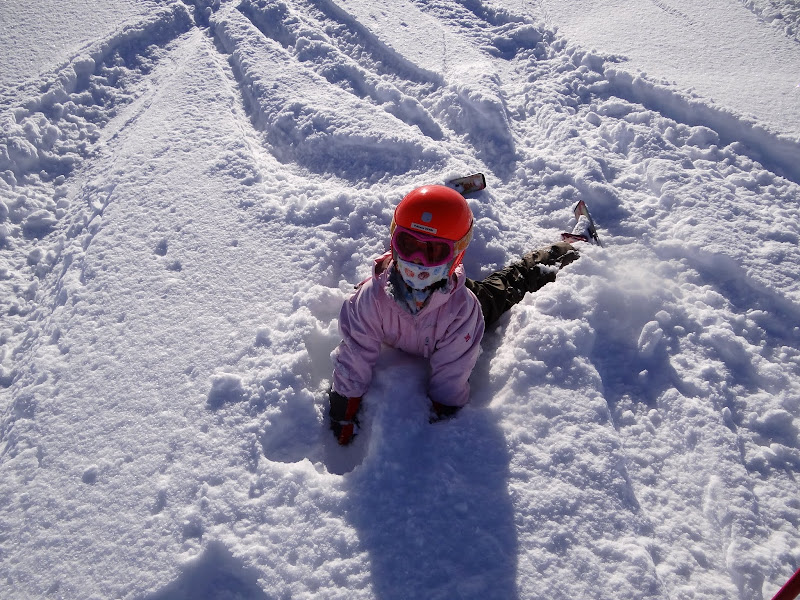
Alex is in there somewhere! Yes there was far too much snow on the slalom course today so we stopped after one run to continue working on technique on the piste.

Warm Up

For our warm up run today I asked Alex to focus on his hips to protect his back and improve his performance. I was thinking about how to improve his overall dynamics for the slalom and what might bring the quickest and greatest changes for him. His lower back and dynamics were obviously being affected by his strong tendency to be stuck in the back of his ski boots and to bend over at the waist. At this stage it wasn’t clear how to go about changing those things because few issues can actually be changed directly. I decided to start with skating because it is one of the three most fundamental aspects of skiing which include Dynamics, Skating and Pivoting – in that order!

Skating

The idea of getting Alex skating was to make the legs active and thus get him off the back of the boots. One unexpected aspect that came to light is that by being bent excessively at the waist he actually couldn’t bend his legs to skate and he had no vertical motion or rhythm coming from the legs.  I suggested that when he bent the leg prior to pushing up he should feel the shin against the front of the boot. This way the leg can function properly for pushing back up. There was only a partial success with this so I simply asked Alex to stand upright when he skied. In this case the cure was that simple! He stood up and skied like that with no difficulty. We then reintroduced the skating and he was able to use the legs better due to being more upright – and his stance came naturally closer together. Alex is simply progressing at a very rapid pace – thanks to having worked on technique and being exposed to all sorts of appropriate experience over the past two full days.  It was clear that Alex now had to develop the skating timing much more. We need to see much more “down/up” motion in his skiing – from his legs and well as from his dynamics.

I asked Alex to just observe the pressure changes beneath the feet as he shifted his centre of mass from one turn to another. He felt it and described it as “weird” – which is great because it means he was sensing a different perspective. Alex wasn’t able to guess what this sensation resembles though. The pressure changes “happening to the body” resemble skating – even when you are not skating. This is how closely linked the skating is to dynamics. The skier has to identify this phenomenon and tune into it. The natural down/up timing is correct for the body and for the ski equipment design – but international ski schools still foolishly teach the opposite up/down timing. Unfortunately those who learn this up/down timing with a pole plant at the end of the turn  tend to be led by their pole plant into this perverse movement even when they try to do the opposite with their legs (a problem affecting Mike on steeper terrain)

The skating exercises we used included simply skating straight downhill and then falling over more laterally (inside) to generate turning – but keeping the skating going. We also worked at skating several times inwards during each turn – starting with four skates and working down to a single skate. I pointed out that placing the hip correctly (pulling it back) lets the body skate much more easily right from the first skate into the turn.


Pivoting

We practised pivoting and sideslipping are each opportunity when the terrain was appropriate. This work has enabled Alex to naturally narrow his stance in just a few days. When on relatively flat terrain I had Alex work on 360° spinning by controlling his edges – always getting onto the uphill edges as the skis come around – and narrowing the stance to avoid catching an inside edge. Within a short time he managed this correctly and once again this narrowed his stance even more. When asked to ski standing upright later on he maintained his skis at hip width apart – which is new for Alex.

Dynamics Part 2

Keeping in mind that tomorrow is our last session I pressed on and started to introduce “end of turn” dynamics. The point is that the skating up action is to assist the lifting up action of the ski taking the skier up and out of the turn. This means that in flowing dynamics the skier ends the turn perpendicular to the slope having been supported by the lower leg well beyond the vertical. This of course means that the next turn is going to happen and the commitment has already been made. If we visualise the slope as flat instead we can see that this really corresponds with the image of a motorbike coming up out of a turn – the only thing is that for the bike vertical and perpendicular are the same thing and for the skier they are not. The skier has to separate those two things and is in a sort of “free-fall” state with gravity being the motor. If gravity is always resisted by not coming out of the turn over this lower leg then the motor can’t really get going – just like a real motor with the timing all wrong.

I demonstrated “hanger turns” by coming out over the lower leg and going slightly into the next turn on that same leg – but there were too many people around for either my demo to be great or for Alex and Mike to have a great chance of copying. We continued to focus on the push up from the lower leg to control momentum when skiing on the steeps of the Face in poor visibility. This was in contrast to previously focusing on pivoting when it was bumpier there and the bumps controlled the momentum more. This is how you learn to pick appropriate technique – emphasising one of the three fundamentals. Here, skating was the most appropriate – not skating for speed but skating to direct momentum and to check speed.

Tuesday, February 18, 2014

Alex 2

Alex should probably have been selected for the Sochi Olympics ski acrobatics team – however at only 8 years old he is probably not eligible yet.

It was a busy day and a lot of progress for Alex including Slalom, Off Piste, Bumps and jumping plus a lot of work on technique including pivoting, carving and control of posture. His skiing is starting to look good.

If the videos seem to focus on Alex’s dramatic crashes it’s only because he loves to see them!

Slalom 36 Seconds

The thing to see in the slalom video is that Alex is not inclining enough into each turn. He feels like he is inclining a lot so it was important to film this so that he could see the reality for himself.  He tends to bend over forwards, compensating partly for being quite hard against the back of his ski boots and this gives him the illusion that he is getting close to the ground by falling into the turn. There are many other technical issues but the most important have to be dealt with first.

On his final run he did incline better and this increased his speed but he wasn’t ready to deal with the increased speed – which requires more inclination again. When he gets that right then we can modify his timing. The slalom course provides clear feedback  and exposes problems so that they can be much better dealt with.  His first timed run was 37.8 seconds and second run was 36 seconds. He should be able to get down to around 31 seconds with some work.


Bumps

We repeated yesterday’s pivoting and sideslipping in the bumps but this time I added “compression” timing to introduce the idea of coming down with a strong leg flexion into the turn. At speed the bump compresses the legs in this way – but when done slowly the legs have to be both contracted. Mike finds this difficult because he blocks the motion of his centre of mass into the turn with the downhill leg and so he can’t easily flex down into a turn. His usual formula is to come up instead, force a turn through some form of twisting and then lift the lower leg out of the way before it causes the skis to cross. We need to break this habit! Alex in contrast is managing to pivot better in the bumps and sideslip better. This is steadily bringing his feet closer together when skiing in general and helping his overall stance.

We later on looked at Mike’s pivoting and it transpired that he hadn’t understood that the foot can be on one edge with the ski on the opposite edge (due to the shaft of the ski boot). It’s necessary to pivot from the uphill ski with the ski on its uphill edge and the foot rolling inside the boot onto its inside (downhill) edge. The ski meantime remains on its uphill (outside) edge. This allows the ski to slip into the turn with no edge resistance while using the adductor muscles on the inside of the leg to keep the body firm. There is no “twisting” involved – it’s a lateral movement relative to the skis led by the centre of mass.

Real Inclination!

Off Piste

Alex did well with no falling over on his first major excursion off piste. He managed to get a good bouncing rhythm and use it for subtle turning. Despite this being only his second time off piste he was already hooked. Later on we we went into some steeper snow but the snow was sun crusted and wind packed so it along with being too steep this was too difficult for either Mike or Alex to turn in. Alex only had one fall in the crusty snow and unfortunately dropped his ski pole down the mountain. This is where he now has to realise that it’s important to not let go of the poles each time he falls. I tried to work with Mike to get him to move the body over the lower leg to prepare for a turn in the deep snow but he was determined to keep that leg jammed downhill below the body and preventing the turns from happening. We need to work on that in slightly less hostile territory.

Posture (Chi Hips) - Carving

Alex was constantly complaining about his lower back hurting so despite posture being a very difficult issue for most people to deal with I felt it was important to tray to do something to protect Alex’s back. We began with an exercise with the arms where both ski poles are pointed towards the inside of the turns, but the outside hip in the turn is pulled backwards. Most people when pointing the poles inside the turn would automatically let the outside hip rotate outwards – so this makes it a really conscious effort to do the exact opposite. Mike seemed to immediately turn more effectively when using this exercise.

The next exercise was to get Alex to hold my pole handles while I stood in front holding the opposite ends – to keep his shoulders immobile. Meanwhile the idea was to get him to move one hip back at a time and to feel the twist in the spine ( up the axis of the spine). This tightening is what strengthens the core and allows the upper and lower body to connect properly. Most skiers miss this because the ski pulls the hip forward during the turn instead of backwards. I explained to Alex that he had to do this on every turn. This clearly worked because even on the last run of the day down the face de Bellevarde he had at least a 50% improvement with his back – and the short turns on the steeps are very difficult place to apply this coordination when learning it.

We used the chi-hips in carving too and Alex eliminated his back pain.

Monday, February 17, 2014

Alex 1

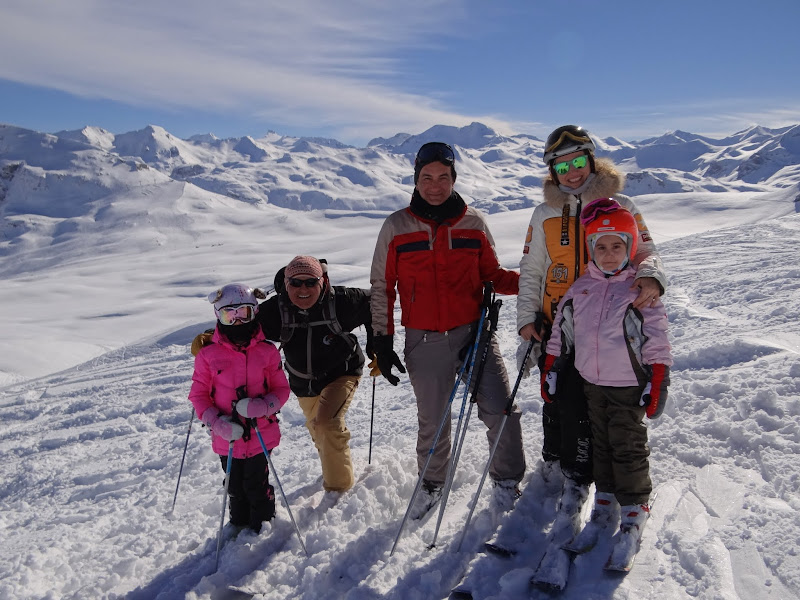
Alex and a clear blue sky!

Off Piste

From the first run of the year Alex looked surprisingly comfortable. Dynamics just works and is so natural that because he was never taught anything else he just steps straight back into it. With this in mind and exceptional powder snow all around his initial warm up run was converted into his introduction to deep snow. Now I knew that this was going to cause tumbles and loads of difficulty getting back up out of the snow for Alex – but with Mike sweeping up the rear it meant that a lot less time would be lost. Patience is needed for adaptation to take place naturally. Alex did extremely well and after only a few runs he stopped systematically falling and could both stay in my tracks – using them a banked tracks like a tight slalom – or make fresh tracks when it was steep enough. I had to remind him to use his dynamics and lean strongly into the turn because his apprehension initially caused him to stop moving inwards and that’s why there was difficulty to begin with. He listened to the correction though and applied it. Alex continued to take big tumbles when it was very steep and deep – but he was starting to actively correct this very well – stopping the skis from overpowering and spitting him out of the turn. His wet hands and feet (for various reasons) started to cause too big a distraction in the end so we finished up the day on the piste – but with bumps, ice and steeps to keep Alex happy!


Got this one wrong!

Moguls

I explained to both Alex and Mike that although dynamics works for off piste, in powder the experience is much better and more playful if pivoting is used. To develop the pivoting we used the Tovière bumps. The main idea was to show how the the pivoting is done with the ski tips in the air to enhance the effect and make it more obvious. This encourages the “pulling inward” because it is very visible and so it also discourages the pushing out of the heels. The key is the placement of the skis across the top shoulder of the bump and the pole planted firmly on or below the apex of the bump. The pole helps the body to angulate and to lead the centre of mass downhill between the pole and the ski tips – while helping to delay the edge change. This allows both skis to pivot directly beneath the feet from the uphill edges..

Practicing this on the bumps both Alex and Mike showed improvement but we couldn’t hang around due to Alex’s freezing fingers. When we had to ski down the Face de Bellevarde, which had some interesting bumps  on it for a change – then Alex was still aggressively edging his skis and running out of control. I made him sideslip down the fall line and then throw in a pivot on a bump and immediately resume the sideslip. He quickly picked up on this and understood that fall line skiing is “braking” skiing and so never accelerated out of control again all the way down the main faces.

Wednesday, February 12, 2014

French Mountain Escapes

There are bargains available in Chris’s luxury chalet – top chef – on call minibus etc,for the upcoming busy half term weeks, 15th Feb onwards…

www.FrenchMountainEscapes.com 


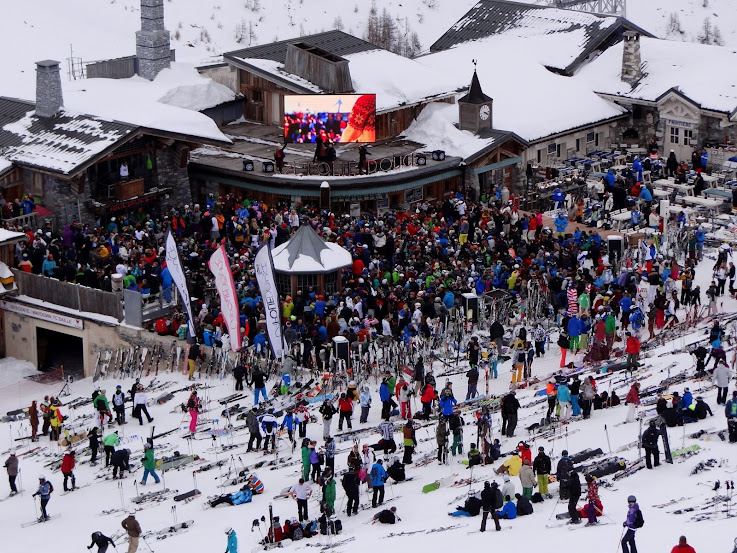
This is what we need to escape from (Folie Douce in Val d’Isère last week!)

Friday, February 7, 2014

Derin and Zeynep

Afternoon Derin in the Morning

Completely different weather today- wind from the North West and clear skies in the morning, getting warm by afternoon.

Little Derin was not as chirpy as usual and it turned out that she had been late to bed so she had more desire to sleep than ski…however as usual she skied completely without complaint. Even a face plant in deep snow for Derin just becomes an excuse to play with the snow! This was perhaps the last day of skiing for Derin so the most important thing was just to take advantage of the conditions and add as much as possible to her mileage, increasing her speed whenever possible. I was impressed at her intelligent management of speed and line.

This encouraged me to let her ski in front as much as possible. On green runs where she was confident her skiing was completely parallel. She could stop at will by turning tightly and negotiate fairly steep, icy and narrow paths. She even figured out that bumps could be used to make turning easier. Only the deep off piste posed a small obstacle for her because of her lack of weight for pushing through it – but when she wanted some speed she cleverly looked for tracks already made by others. Nobody told her to do this she just figured it out.


Safety

The only negative of the day was the stupidity and lack of respect of many out of control boarders and skiers. It was by coincidence that I met up with French ski teacher and friend Olivier Sante who told me he is mounting an association to deal with the lack of respect of the mountain safety code – to at least force the ski schools to teach it. Personally I don’t think it will make any difference because the problem is one of selfish attitude, drugs and broader education.


Zeynep

Carving

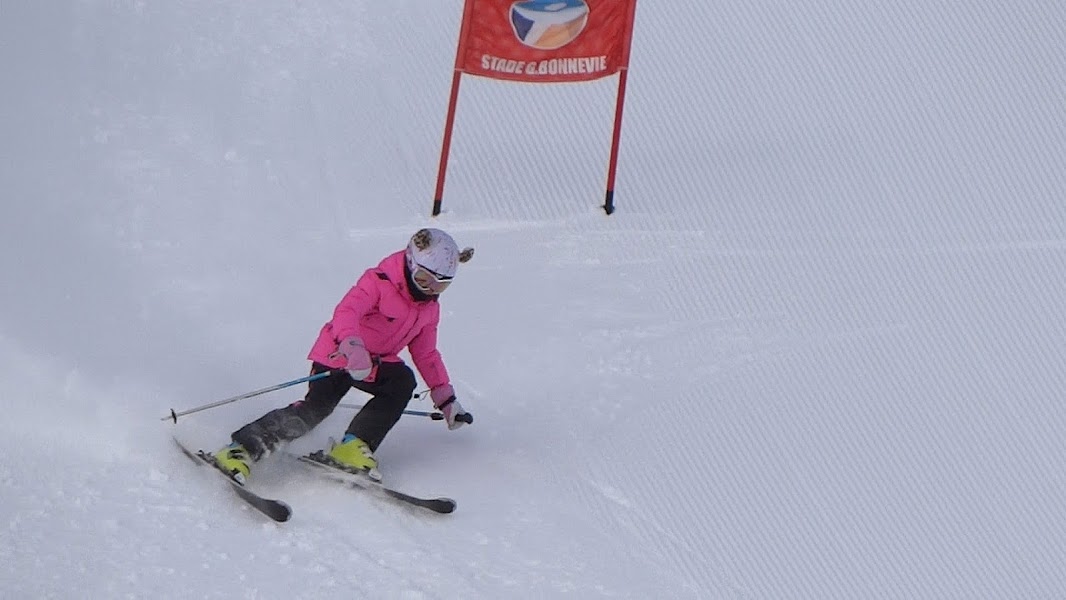
Zeynep managed to collect the equivalent (it was on the  Bonnevie Stade – which is harder than the actual race) of the bronze in the “Fleche” race in the morning – so she was obviously happy about that. She used the dynamics and said that she didn’t slide sideways so much. We were going over to the slalom to do some work on technique but before hand I wanted to improve Zeynep’s carving a little.

The first thing I wanted Zeynep to do was to roll her feet inside her ski boots. She didn’t know anything about how to use the feet, but without going into a separate lesson on the feet I had to just give her a general idea. The feet have a total of 52 bones and 214 tendons and ligaments – so they are mechanically very complex and can’t be just ignored. They are our only contact with the ground and all our reflexes depend on the way they deal with pressure. To simplify things we can think of the edges of the feet corresponding to the edges of the skis. I asked Zeynep to roll her feet to the left – onto the left edges to make a carved turn to the left. The edging should be done by the inclination of the centre of mass supported by the rolling of the feet – not by pushing the knees inwards. I had Zeynep hold onto my ski pole and pulled her sideways towards me so that she could incline and edge her skis with me supporting her – then I did the same the other way by pushing her away from me. While the body was inclining I asked her to roll her feet onto the correct edges.

We then tried this in traversing across the hill in a carve – both feet rolled uphill. Zeynep had trouble getting the left foot to roll onto its outside edge when traversing/carving with the left side uphill. eventually she managed to make a two-skied track in the snow with two cutting edges and the legs symmetrical. The real reason for having the “inside” foot (relative to the turn) on its outside edge is just for body symmetry.

Once this exercise was working a little better I just asked Zeynep to link carved turns without skidding on gentle terrain – with the feet rolling supporting centre of mass moving inwards from turn to turn.

Once she had practised this for a while I demonstrated how far over it is possible to incline with dynamics at speed when carving and so she had a go at it herself – and then it was time to go over to the slalom.


Slalom

Slalom lasted about 3 turns and with the new speed gained from carving Zeynep was thrown straight out of the course! Now she has to learn how to generate more dynamics so as to deal with the effects of her better grip (she is no longer brushing off speed by skidding so much). The speed control now has to come from increasing the dynamics so much that the turn tightens and so the new line of travel does the slowing itself. Slalom courses are set to special rules to have this effect.

Skating

We briefly revised “skating into skiing” to ensure that Zeynep could still move with the right timing and rhythm. This was also to help her feel movement in the legs – something she loses when “resisting” with tension in the slalom and in challenging situations. She carried out the exercise well and this was preparation for going off piste. The whole base of the ski builds up pressure in off piste snow so the lifting power of the ski is much more powerful and this then requires more dynamics again to stay inside at turn. The skating timing gives a clue as to what to look for when the skis begin to “bounce” in the soft snow. We have to tune into this rhythm and use it.

Off Piste

For off piste I just told Zeynep to more her body – with dynamics. You can’t overdo the dynamics and if anything goes wrong it will be because to not using enough dynamics. We went into her first real off piste excursion ever into soft deep snow  and I knew she would be fine because of her understanding of dynamics. She only had one fall at the very end and discovered how soft and forgiving powder snow is.

Bumps and Pivoting

I showed Zeynep how to use a bump to help the skis turn. You place the skis on the bump with the tips in the air then plant your pole downhill. Use the pole to let the body fall in a controlled way between the ski tips and the pole and when the skis begin to slip then pull both tips inwards. Once this had been practised for a while we did this while on the move.

Steeps Off Piste

Visiting some steep off piste I showed Zeynep how to use the bump/pivot movement to initiate a turn in really steep terrain. She did this successfully. It takes courage to do this because you have to overcome the little emotional voice in your head that tells you not to let your body fall down this steep hill. When Zeynep tried this on steep terrain she got it right, but when she completed the descent wih dynamics she didn’t complete her turns enough and so the speed started to get a bit out of control. This is what slalom teaches people – how to fight to hold yourself down into a turn and allow pressure and energy to build up and to then release this energy by letting the ski bring you up towards the end of the turn – once your direction and speed are controlled.

Wednesday, February 5, 2014

Derin and Zeynep

Derin

One word describes the weather today – “harsh”!  80km/hr SE freezing winds at altitude and snowfall getting stronger all day with poor visibility at best, except low down at Tignes les Brevieres. The only advantage of this we experienced was that the gondolas were empty from Brevieres so with Derin fitting nicely on a bench she managed some proper rest and recovery. Until now Derin has been happy about growing but she was disappointed to realise that by next year she probably won’t fit the gondola bench any more – at least without removing her helmet and boots. 

Most of the morning was about dodging the worst of the wind and weather and trying to find shelter to fit in a few exercises when possible. We practiced wide stance dynamics to make rapid, grippy, edgy and aggressive turns and emphasise the use of the centre of mass. This was also to help to keep warm. I continually corrected Derin for her arm carriage and encouraged her to keep her arms forwards – which helps to keep her off the backs of her boots. Asking Derin what was the main thing she should focus on when making a turn she still didn’t realise that it is the centre of mass – and that we have to move this point to make our turns. Although she uses dynamics in her skiing she doesn’t really seem to be aware of the centre of mass – especially when making either really big moves such as in carving or very fine moves such as in pivoting. She is certainly not aware of how changing the shape of the body (angulation) affects the centre of mass – as her difficulties in pivoting demonstrated.

Pivoting

We worked on pivoting for a while but she was struggling to use the pole for a support and to relate it to the motion of the centre of mass – which actually controls the pivot. She would get her body stuck uphill on the uphill edge then try to force the ski around instead of moving her centre of mass downhill with the support from the pole. Even when succeeding the start of the pivot there would still be a twist and push out of the skis later on – which means she wasn’t really feeling the correct mechanism. She was getting very close and I intended to persist with this but instead we ended up just skiing to keep warm. Her pivoting problems are related to her long term tendency to be in the back of her ski boots. Mastering the pivot with some angulation and pole support would go a long way towards helping to eliminate the use of the rear of the ski boot for support.

As usual when it is windy Derin was struggling to cope with the cold. She is very thin and simply can’t hold enough heat. Sure it was harsh weather – but only from the point of view of teaching/learning and staying focused on those things. She said her legs and feet were cold but not her upper body – but keeping the core temperature up usually keeps the legs and feet warmer. She never asked for her extra top but she should have been wearing it systematically. I knew before the day started that she would struggle with this cold. Clothing! Clothing! Clothing! – as somebody said “There is no such thing as bad weather… ” If she was dressed like an Eskimo (and ate more perhaps) there would be no cold  – end of story!


Best gondola ride of the season!

Zeynep

Little Derin was persuaded to stay in out of the cold so this gave Zeynep the chance to come out for the afternoon – even though she had also been out all morning. We both knew that the trip back from Les Brevieres was cold so we took the risk of going the opposite way – up the train to the Grande Motte. During the wait for the train I used a stone surfaced concrete pillar to help to explain dynamics to Zeynep while we were inside in the warm.

The first video is Zeynep skiing with the standard ski school technique which she executes correctly – sinking down to plant the ski pole and then standing up to start the turn transferring weight to the outside ski – by moving the centre of mass over it. She look stiff and unstable – as is predictable. Her wish was to be better at slalom to improve her race times – so that meant she would need to learn about alternative ways of moving!


Dynamics (There is a fixed page on the subject at the top of the blog)

I used the pillar to get Zeynep to move and push against it for support – explaining the various effects at the level of the feet. Before doing this I asked Zeynep to transfer her weight to the right ski as if she was turning to the left on skis – and she moved to the right! I then showed that a quick move to the left caused pressure on the right foot and then if the pillar was on the left it would continue to give support and maintain this pressure on the foot. I showed how a slow movement placed the pressure on the left foot. The pillar made it easy and comfortable to demonstrate the range of effects of dynamics. Just like the pillar can never be pushed away and so there is no chance of falling over – the lifting power of a ski is every bit as strong and makes sure the skier will never fall over when making this move.

The analogy of a motorbike going into and out of a turn – leaning down into the turn – helped Zeynep understand the subject better. She could see that this timing was the opposite of what she was used to.

I explained the Zeynep that her job is to fall over to the side and the ski’s job is to lift her back up – but the ski can’t do its job if the skier doesn’t try to fall over . The ski provides a force that is effectively every bit as strong as the pillar for holding you up.

We repeated the exercise statically on skis and then in action with turns to one side from the fall line. Zeynep moved with ease and could feel the mechanism. Before long Zeynep was skiing with dynamics.

The video is Zeynep getting used to moving the centre of mass and also adding skating at the same time in the second scene…


Skating

Before bringing skating into her skiing I had to teach Zeynep how to skate better. This only took five minutes.  I stood in front of her facing her on the flat with my ski poles held horizontal in front of me. I asked her to diverge her skis and to grab my pole and push me backwards. This caused her to lean forwards and to push from the insides of the feet. When she repeated this -  leaning forwards  but without me there – she accelerated in proper skating. Skating uses gravity with the body falling forwards – and skiing is only an extension of the falling. We tried skating downhill and then making the forward fall more lateral until it developed into dynamics and skiing. I explained to Zeynep that the timing of skating is “down/up” and that matches the timing of dynamics with is also “down/up”.  Everything works this way – from a bicycle to an aircraft to a skater to just somebody changing direction when running.

Zeynep picked this up very quickly and showed that she could connect with the right feelings and understand them. Her legs immediately began to look functional instead of stiff and her overall body movement looked natural.

She asked bout using the knees to “carve” and so I explained that the knees are never to be pushed inwards to carve because that risks breaking them. Carving comes mainly from the inclination of the body due to dynamics and partly from hip angulation created from skating – but not from the knee. We didn’t have time to look into greater detail but the knee can appear to move inwards when the muscles on the inside of the leg are tightened – but this is not a “twisting inwards” action.

Arms and Poles

I asked Zeynep to hold her poles across in front of her to bring her arms up from her sides and out in front into the “ready” position. When the arms hang low by the sides this pulls the body backwards and downwards. I then showed her how to get the height right by “walking” the poles stabbing them into the snow with just a flick forwards form the wrist – continually as we moved forwards. The “pole touch” on the snow when skiing should be when the centre of mass moves into the new turn – it’s the body going down into the turn that causes the pole to touch the snow. The pole does not go into the snow at the end of a turn and is not followed by an up movement. They stopped teaching that nonsense in the USA in 1992. Zeynep has to watch when she skis that if she uses her poles she might find this sending her back to her old ineffective timing along with the rest of her movements.

Pivoting (There is a fixed page on the subject at the top of the blog)

Now that Zeynep understood dynamics and skating she would be able to see them in some skiers. I explained that when she didn’t understand those things they would have been invisible to her. Our vision is dependent on the database inside our brains and can only see what we understand – which is the reason why new born babies are blind. People make the mistake of thinking that they can look at something like skiing and work out what is going on – but that is not how it works because they will only see what they understand.

To emphasise this point I decided to show Zeynep “pivoting” and to ask her to watch and tell me what the major difference was. She couldn’t spot it of course! It’s that the first half of the turn is made completely on the outside edge of the ski. I had her hold my pole and assisted her through a few pivots until she could feel the sensation and understand about the edges. I then explained that this is why I had been holding little Derin this way when skiing with her but that nobody can see or understand what we were actually doing! This is why little Derin can already ski parallel off piste and has never needed a real snowplough – which uses the wrong edge for a beginner in the first half of a turn – but the right edge for a racer!  All the things we worked on today were similar examples of “opposites” that are invisible to people who do not understand them.

Tuesday, February 4, 2014

Two Derins

Morning Derin

Derin was a bit negative to start with but we had a chat about it and agreed a plan for the morning. I explained that sometimes to get better at things we have to work seriously and that her time with me was really for learning not for playing. However, success at learning and improving can itself be much more fun than just playing and not ever really improving. If your skiing improves then skiing simply becomes very much more fun.

Fear

Fear can sometimes get in the way. Everyone has fear and being brave means standing up to that fear and conquering it – which is often the most important part of personal growth in life. Slalom can be scary, but it is the best natural teacher we can ever have for skiing and conquering our fear of it brings us great freedom… Everyone can do this – without exception – but how do we get there in practice?

When doing some of the exercises Derin was not managing to make the physical changes so I explained how to succeed. Skiing is not academic – where you just have to think. Here you have to connect your thinking to your body – it’s the real world not the academic world of the classroom. I told her to connect her thinking to her body and to focus on doing so. What happened next was no surprise to me. Not only did Derin succeed but she started to enjoy the process. Skiing is like a meditation – where the focus must be directed deep inside your own body and physical processes. This is really how fear is mastered and how people become centred within themselves. The distractions of “playing” or worrying about “what time is it” vanished from Derin and she was clearly enjoying the skiing. Fear? What fear?


Wide Stance

Technically, the main issue for Derin to focus on was simply keeping a wider stance.

I had Derin stand stationary beside me with a narrow stance and hold onto my ski pole (the same way that I do with little Derin when skiing). I pulled Derin towards me making her incline, then I pushed her away making her incline in the other direction. She could feel that a great distance had to be travelled by the body to get from the inside edge of one ski to the inside edge of another.

Next Derin had to stand with the feet very wide apart. Moving the body from side to side she could feel that the inside edge was very easy to access with very little movement of the body. This is the reason why when developing a good support for dynamics from carving it’s much better to keep the feet forced apart.

In the slalom Derin succeeded in keeping the legs further apart than usual and as a result carried more speed – but she still didn’t have the experience needed for using it strongly yet and when reaching the steep part of the slalom she reacted by losing the wide stance instead of increasing it as would have been more appropriate. The slalom however was before we had done the above exercise. Later in the video she skis with successfully maintaining her wide stance and this corrects her timing and dynamics (compared to yesterday when she was late in coming down into the turns) and smooth's out the turn initiation showing good grip from the skis. She could clearly feel the difference and improvement.

Arms and Poles

Derin has a tendency to ski lazily with the arms so I showed her how to carry them – first of all by getting her to ski with the poles held across the front of her body  - then by “walking” the poles  - stabbing them into the snow on both sides of the turn in rapid succession with only the wrist moving the pole. This exercise gets the arms at just about the right height and in front of the body. Derin had to use this wide and forward arm carriage at the same time as the wide stance with her skis.

We skied sections the lazy way – arms by our sides and legs close together with slow global movements of the body – then switched to the dynamic way with feet and hands wide apart with rapid movements of the body – and the difference was dramatic.

Bumps

Derin was initially afraid of the bumps but I coaxed her into them by first using a ridge where we could, standing  stationary, place the ski tips in the air and plant a ski pole further down the ridge. With a motion of the body between the pole and the ski tips the tips would swing around and sideslip down the opposite side of the ridge. Taking this into the bumps the only thing I had to emphasise was that – just as in carving the turn initiation required a down motion – but with the legs bending much more in this case. Derin initially popped up instead – but she soon understood. She ended up deciding that instead of being afraid she really liked the bumps.

Part of the use of the bumps was to develop her pivoting skills and use of the poles, arms and angulation – without her actually realising any of this. The bumps require a close stance – feet together – because in this case you do not want to get on an inside edge – the exact opposite of racing turns.

Afternoon Derin

Derin stepped up another gear today as her confidence grew. Now she is not only parallel when she carries a bit of speed but she comfortably ventured off piste for the first time ever with no problems at all. Prior to taking her off piste I could see that her dynamics (global body movements) were good and so it was obvious that she would experience no difficulty – other then negotiating the lumpy terrain and getting used to the deeper snow in places.

Derin makes up for her lack of English creatively – saying “…it’s so up” to mean “it’s so steep” and “… up,up,up,up,up,up…” meaning “high” – with the number of ups increasing with the height! The most I’ve heard so far was about 16 ups when the Borsat chair took us up into the clouds.

Derin is picking her own line and intelligently controlling her own speed with me only giving the general direction and occasionally instructing her to go in a straight line for extra speed to better anticipate a flat spot or a climb further ahead. Her speed tolerance has increased sharply. There’s not a lot to say here because the video says it all… (We decided that she is already better off piste than Okan!)


Monday, February 3, 2014

Two Derins

Morning Derin

Cold and Clothing!

There was a very strong wind from the South East which made going over to Val d’Isère from Tignes a bit unpleasant. Once on the other side the Bellevarde was strangely calm and windless so we were fine in the area for working on slalom. It seems the wind was as localised as the clouds. Derin however just wasn’t wearing enough clothing to stay warm later on. The past two times when skiing with her she has suffered from the cold – while I have remained fine because I have five layers! This is my “light“ dressing too – with a very thick down jacket at home for the really cold days! Children don’t have the body mass to hold heat so they need to be wrapped up very well. We did stop for a warm up and drink to look at slalom video but Derin drank only cold water so that may have been a mistake!

Slalom 31.51 seconds

During our first two runs I checked Derin’s carving. Her timing initially looked great but the start of each turn seemed delayed and with the skis skidding. She also seemed to be sinking into the turn late. I videoed her from behind and then we went to the slalom to establish a reference time for her. During filming from behind the spray from the skidding almost hid her from the camera at times – but she was very lively. The course was in very good condition and almost empty so this would give her confidence. Due to the course conditions her first run was her fastest of the day. She enjoyed it! Last year her best time was 33.55 seconds so her first run was a personal best by 2 seconds at 31.51 seconds. We tried a few changes with dynamics and timing in the slalom but could not increase the speed with seven runs so it was obvious that we needed to sort out some technical issues away from the poles first. The goal over the next few days will be to get the speed under 30 seconds – through improving technique.


Derin has good inclination in the photograph – but she got there by drifting sideways and losing grip with the outside ski instead of the far more secure way of having a solid grip and moving the body inwards. Our work on carving aims to change this so that the body can be moved with far more confidence. Derin moves with great dynamics when off piste and has a deep track to follow – because she sees the banked wall of the track in front of her – but she has not yet identified how to generate the same movement on piste.

In the slalom Derin is not able to take an efficient line due to the skidding of the skis. With the skis skidding excessively at the turn initiation she cannot generate enough inclination or dynamics and so then she drops down into the turn late when the skis are downhill and she feels more secure. Until the turn initiation is sorted out she will not have any choices available regarding timing or tactics. With this in mind we set off for the Grand Pré to work on carving. (We managed to fit in an off piste descent on the way…)

Carving

We worked on leaving railway line tracks in the snow  - in a shallow traverse - by edging both skis and using the centre of mass (belly button) to move the skis onto their edges. Derin has a tendency to try to use her knees instead and this has to be corrected for safety reasons.

Stationary and using ski poles for support I had Derin working at changing edges just by moving the centre of mass from one side to the other – with changing onto the downhill edges being particularly difficult due to the need to use the poles for support and to avoid using the knees. Derin had to understand that edge changing requires this clean movement of the centre of mass – with no skidding from the skis at the start of the turn.

The video shows Derin working on this after the slalom – but there is still some spray visible and the turn initiation is still slightly rushed – as if she is looking for a braking action and not an accelerator. We had to keep moving due to the cold so we couldn’t spend as much time focused on this subject as was really needed. We can pick it up again first thing tomorrow.

Derin also needs to learn to maintain a wide stance while on two edges. This makes carving much easier and it allows rapid support from the inside edge at the start of each new turn. It is the best way to develop dynamic range – moving the body from a solid platform – the ski carving and locked on – or even if skidding all the body parts pulling inwards in the right direction.

When the skis begin to grip properly then we can work on timing to seriously improve slalom times!

Short Swings

To try to warm Derin up I asked her to do a series of jumping short swings but she couldn’t do them. This requires pole support, angulation, being centred on the skis and in the ski boots – plus accurate coordination and dynamics. Tomorrow she will be working on this for sure so she needs to eat plenty of porridge for breakfast!


Afternoon Derin

Derin is going through an “expansion” phase – where her universe of skiing experience is being rapidly stretched. Today she skied from the top of the Col de Fresse by herself. Not only did she ski unaided but she picked her own line and established her own control – while I was filming and generally keeping an eye on her. (I noticed that she skis faster when the camera is on her!) On the way up to the Col she was very scared – which is not surprising when you are going up a big mountain in a howling wind at the age of five and not really knowing what to expect. I reassured her and allowed her to hold on to my pole at the start where  it is quite steep. Once she got into her rhythm and focussed on her skiing she was fine on her own. All this effort of course merited a hot chocolate at the bottom – the round trip taking about an hour. Next time up there was no fear and she skied entirely on her own.

The plough she is using is not a problem. She initiates the turn by pulling her outside ski inwards and that is fine. She is not trying to push the tail outwards. She also naturally moves her body inwards in the direction she wants to go. There are no rotational problems of the body or parts of it. The only “fault” that can be seen is that she is in the backs of her boots – but at this stage that also is not a problem. Part of the “back of the boots” issue is that she is naturally pushing her foot forwards – which is great! She will progressively come off the back of the boots when her “expansion” phase is over and she is able to accumulate mileage, speed and experience. The boots, the wide stance and the wedge are being used as balancing aids - as was my pole - but she has been trained from the beginning to fundamentally use dynamics (accelerations) and so bit by bit the natural accelerations will grow to replace the balancing aids. She has already abandoned my pole, the wedge will go, the stance will become closer and she will stop leaning on the boots – all because of natural dynamics. Eventually we end up with “flow” instead of balance – as Okan commented when he watched the video of Haluk skiing powder – it looks like dancing.

Her universe is still growing just now and she is the one in charge – she isn’t having to even follow me! Her ability to straight run at speed increased by 200% today alone. Her distance travelled by about 1000%, and her ability to chose a line for control of speed also by about 500%. It’s like a big “waking up” process!


Sunday, February 2, 2014

Haluk and (Mini) Derin

Haluk

This morning was an off-piste blast that was needed by both Haluk and myself – not a technical session.  The possibilities didn’t look too promising as it was heavily overcast and still snowing but with not a great depth of fresh snow at 2000m. The clouds were denser at lower altitude so the best option seemed to be to take our chances and go up to the top of the glacier at 3500m. Lack of wind meant there might just be some real snow up there and it might all be above the dense clouds and so have good visibility. That turned out to be correct and earned us a whole morning of skiing fresh tracks in 20cm of powder with very few people around to beat us to it.


Haluk uses the “Chi Skiing” technique and so was able to protect an injured back from earlier on in the week. Not only was the back protected but it felt better after a few hours off piste in some challenging snow – with breakable layers below the fresh snow. The chi-hips movement is literally therapeutic for the lower back and  practically everything else. Posture is activated correctly and the working load is shared across a full range of muscles up to the core so that the legs don’t get significantly tired.

Haluk still needs to swap (reduce) some ankle flexion for some hip flexion. Bending more at the hip by changing this geometry around would make the skiing lighter, more nimble and responsive – and also protect much better against unforeseen obstacles.


Afternoon Derin

Derin’s brain must have processed yesterday’s data during the night and worked out how to move on to the next level. Straight away Derin was comfortable skiing entirely on her own and even completing the steep and intimidating busy end section of the piste entirely on her own. Her speed increased naturally and this removed most of the wedge that is in her case only a consequence of very slow speed. (Without ski poles at those very low speeds a wedge will be necessary even for a pro so Derin has nothing to worry about there.)

The video here is on the blue run beneath the Bollin chairlift. Later on when she became a bit tired the wedge started to return more strongly so I didn’t insist that she carried on too late.


Derin in her racing stance (With hip angulation that Haluk would die for)…

Saturday, February 1, 2014

Dilshat and Derin

Dilshat

Dilshat let me know immediately that although her skiing had improved over the past few years she felt that her arms were rigid and not right – this being the issue she would really like to sort out. She was also concerned that she felt unclear about when and how to use the ski poles.

Arm problems are nearly always a symptom of other underlying issues so first of all I watched Dilshat ski to get an overall picture. Dilshat’s timing and dynamics were fine but her posture was not strong and she didn’t use her arms at all in her skiing. The (sometimes) rigid arms appeared to be compensating for weak posture.  My intention was to get the body mechanics working better and then deal with the use of the poles later on.

ChiSkiing (Centred Skiing) 

(There is a fixed page on ChiSkiing at the following link “ChiSkiing”)

Why do nearly all skiers end up with back problems? The problem is not that people necessarily have “bad posture” or body awareness, it’s that skiing itself forces the posture to collapse. Posture is reflexive – we have no real conscious control over it. The problem comes from the outside ski pulling the hip around in front of the the body. Very well trained skiers can stop this “hip rotation” but not enough to prevent postural collapse. The classic “face the shoulders downhill” upper/lower body separation is mostly concerned with rotation in the hip joints but also causes some rotation at the base of the spine. This is often referred to as ”winding up” the body – from the shoulders  down to the feet. The ribs end up being compressed into the front of the pelvis and all the postural muscles stop working. Some people end up with  a hollow lower back (like Dilshat) and end up bending the spine sideways – and some with a rounded lower back (like me) and end up in hospital even faster with ruptured discs. Dilshat’s arms seem to be rigid to try to compensate for the lack of connection and support going on with her posture at present and especially the sideways bending of her spine and fairly strong hip rotation due to the hollowed lower back.

However, all is not lost! There is one way to change all of this and it is quite simple in principle. The shoulders need to be stabilised and for the most part just follow the skis but the hip on the support leg must be pulled strongly backwards from the start of the turn to the end. This prevents all of the above problems because it prevents the hip from being pulled around in front of the body and so it prevents involuntary postural collapse.

We did some Chi Walking, uphill, so that Dilshat could feel the difference when the correct mechanics are used even in walking – avoiding the foot and hip moving ahead of the body. Dilshat visibly walked more upright and found it relaxing even walking uphill. I explained that you can walk up an entire mountain this way and won’t even feel tired because instead of just using the quadriceps in the legs you use all the muscles including the glutes and core muscles plus the postural muscles and the load is much more efficiently distributed.

Feeling and understanding this change helped Dilshat recognise what to look for when skiing while trying to pull the hip backwards and avoiding pulling back both the shoulder and the foot.

I asked Dilshat to adopt this stance and to push hard against my shoulder to feel the tension when the postural reflexes kick in automatically. In contrast I also asked her to try the classic upper/lower body separation so that she could feel how there was no muscular activity and the upper and lower body become disconnected. 

Poles to the Inside

To help organise the body more easily I asked Dilshat to ski with both her poles moving to the inside of the turn. This helps to keep the shoulders in line with the skis and to feel only the hip being pulled backwards.

The hip has to be pulled backwards quite strongly to twist the spine slightly (up to the 12th thoracic vertebra – ribs) and open up the space between the pelvis and the ribs. This twist is in the opposite direction from the classic “shoulders downhill” and it causes the posture to actually work – integrating the upper and lower body instead of separating them. The muscle tension creates a “hydraulic sac” compressing the internal organs and then distributing the vertical loads going through the body over the whole cross sectional area of the core – not just through the spine.

Dilshat noticed that when pulling back the hip the turns both started more easily and finished more strongly. It takes time to be able to master this on steeper terrain and in shorter turns. She also noticed that the alignment of the legs was stronger. Pulling back the hip re-aligns the femur into a much stronger position – especially important for women skiers. (Due to the greater “Q” angle of the femurs)


Pole Touch

I explained how the pole is held with the middle two fingers and thumb so that the wrist can be used to swing the pole easily. In flowing skiing it is the body moving laterally into the turn – falling over like a motorbike – that causes the pole to touch the snow lightly to the inside of the new turn right at the start of the turn. The arms don’t move. The pole is swung into position with the wrist only. The pole touch is cause by the dynamics.

I pointed out that the touch also matches the moment that the hip on the outside of the new turn has to be pulled back into place – but Dilshat found that a bit to difficult to connect at the moment.

Pole Plant (Pivoting)

(There is a fixed page on “Pivot” at the following link “Pivot”)

The “pole plant” is the other way to use a ski pole – literally for support! This only happens during braking turns (not flowing forwards). Such turns are often referred to as “fall line” turns and this is what is required in fast mogul skiing. The skis do not travel forwards across the hill – only sideways, slipping into a turn from the uphill edges.

I supported Dilshat through a few pivots from her uphill ski and then explained that my support had to be replaced by the support of the ski pole.

This exercise revealed a weakness in Dilshat’s skiing in that she found pivoting very alien and couldn’t angulate well to put weight on her ski pole. She was able to adapt quite quickly though and with some work could master this subject without too much difficulty. When she tried to link some pivots she revealed a heel push outwards. Although Dilshat generally skis with good dynamics she does exhibit a tendency to push outwards on tighter turns and this issue is made clearer here.  This is why she never uses her poles even in shorter pivoted turns. The pole is a support for moving inwards – not for pushing outwards!


Afternoon Derin

Little Derin has discovered how to control her speed and has suddenly gone from dive bombing straight downhill to complete over-control and turning on the spot. I told her over and over that when on flat terrain she could stop turning – but even when stopped and having to walk she would keep on turning – walking back and forth in turns. This “over turning” is causing a wedge/stem resembling a snowplough – but it is not a worry. The key issue is that her body is moving towards the inside of the turn with the correct dynamics.  When she picks up some speed again then the wedge will disappear automatically. She is controlling her speed by turning not by trying to brake.

At this stage she needs time to explore and gain confidence in herself and her new found independence. The over-control is just a new temporary phase. I started to put her on my ski pole again to pull her faster and remove the wedge stance – so that we can now work towards getting her to go faster on her own but with the confidence that she can turn rapidly and stop when she needs to. She was jumping – to un-wedge the skis and get off the back of the boots and immediately after each jump I’d start a turn so that she would ski the turn parallel again.

Derin’s main concern was that her mum and dad would come to watch her – but much to her disappointment they never appeared so after a second toilet stop we finished a little bit early. She had done a lot on her own – nearly all of the skiing – and I didn’t want to push her too hard as she still feels scared skiing unaided much of the time. She can ski by herself on the blue run from the top of the Bollin and the narrow path entering the green run where short turns are necessary.