Thursday, January 16, 2014

Luke, Tibo, Leonie, Florence – lean On Me

Carving

This morning everyone was on short skis – though the 120cm skis were not really reactive enough for confident building up of dynamics. I found that they performed more like slalom skis with quite a long carve radius for short skis. In Courchevel none of the shops stock Snowblades anymore.  My own pair has vanished along with my 150cm World Cup Fischer slalom skis – probably lent to somebody. Leonie and Florence needed an introduction to carving on the blades so we repeated the carving lesson from yesterday – with rolling from edge to edge of both skis on the flat with a toppling of the centre of mass. Leonie had a tendency to push her hips to one side and keep her head and eye-line in the horizontal.  I explained that the head had to incline with the body to line up with the resultant forces in the turn – and not remain in the horizontal. Horizontal is only useful when we are relating to the vertical. At first Leonie couldn’t hold the ski on edge and would allow the ski to flatten and drift instead of carve but this was sorted out in a few minutes. We didn’t spend long on carving because the slope was a little bit too steep, so we moved onto pivoting.

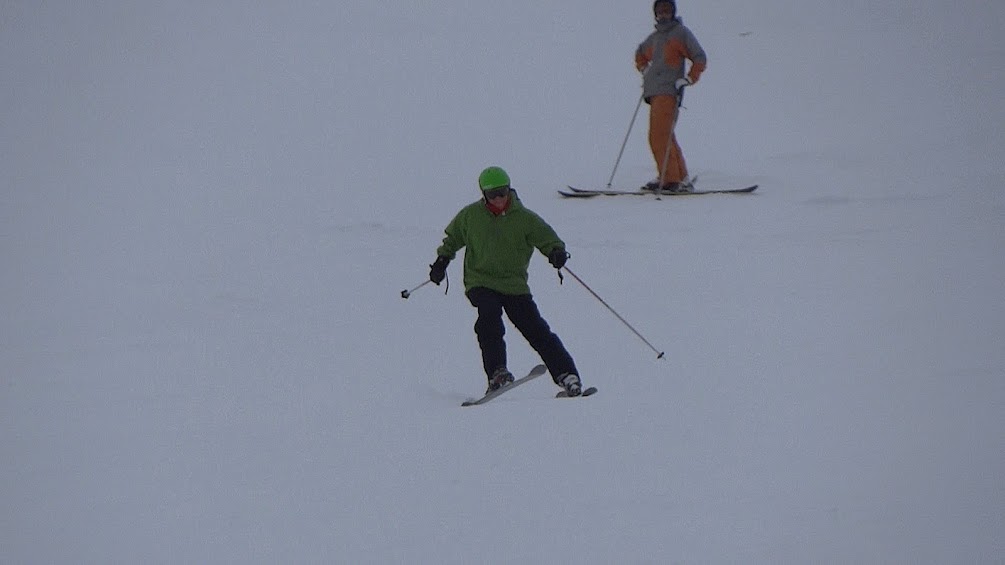
Later on, near the end of the session we returned to carving and I got Leonie to “Lean On Me” with a view to refreshing how to generate active dynamics. The blades are excellent for developing active dynamic range so I wanted her to move more and she did achieve this. Later the sentiment was captured in song by Luke and Tibo in the following video clip…


Pivoting

Somehow Luke manages to initially do every new exercise correctly and then eventually to find a way to return to being glued to the back of the boots and skis. Yesterday the blades allowed Luke to be well centred but today he was in the back seat once again even on the blades. Leonie responded well to pivoting in a wide stance with the feet held at the same altitude on the hill (instead of one above the other). Getting Leonie to remove her skis I asked her to face downhill and jump, turning both legs in the hip sockets, landing with the feet facing the opposite direction (from left to right etc). When back on skis the idea was to feel each leg pivot independently. Leonie understood this and for the first time was able to get control over her hip rotation as a result. 

I helped Luke to feel this by physically pulling his skis through the manoeuvre – but although he seemed to get it at first he couldn’t retain it.  The right leg in particular was troublesome. Luke needs more time to develop awareness of the body in space and the relative positioning of the feet to the body – plus to be able to discern the causes of the physical differences in action between the two sides of the body. When you can do something well on one side and not on the other then main the issue is body awareness.

Tibo had an issue with rotating his pelvis into the turn with a major twist of his spine – so I pointed out that he was actually supposed to pull the hip backwards – the opposite direction – and that his current spine twisting could be very damaging to the body. The wide stance pivoting was partly to help him to realise that the pivoting had to come from the legs and not the pelvis or above.

We did a couple of runs working on this and then decided to head down to change back to normal skis. There were too many dispersed individual issues between the four skiers for enough attention to be given to any individual and so only Leonie had managed to make a real breakthrough. Tibo had also certainly reigned in his spinal cord. I could also see how Luke systematically pushed out his right foot and so this gave me more clues to his issues. Florence just worked along at her own pace and I pointed out that she needed to leave her comfort zone a little bit more to be able to bring about real change from her current situation. More control at lower speeds would give her more control at higher speeds and so lead to greater confidence off piste and in general.

Everyone managed one ski pivoting, thanks to the short skis.

Bumps

After lunch we tackled the black “Sanglier” run down into Meribel and I asked Luke to bend the legs low to try to avoid being jammed in the back of his boots. A permanently flexed stance is called “midstance” and is an old Austrian technique. This appeared to work initially but then the back of the boots took over again. I pointed out to Luke that the foot of the uphill ski had to be kept well below the body – downhill – to be able to pivot. Awareness of the positioning of the skis and their edges is extremely important in this manoeuvre. To go one step further, the edge of the foot and the ski have to be felt separately. Standing on the uphill ski, with it kept downhill of the body you initially stand on the uphill edge of the ski and foot. You let the foot relax and so the ski flattens slightly with the shaft of the boot pushing the knee slightly laterally downhill and bringing the foot onto its inside edge. The boot shaft also maintains the ski on its uphill edge at the same time. Now the foot in on the inside edge and can pull “inwards” pulling the front of the ski downhill into the turn. This pulling accompanies a subtle motion of the centre of mass directly downhill.

I pointed out that Luke needed not only to start to avoid lifting up the tip of his inside ski high in the air but he should really be forcing the tip downwards instead – especially when going down the drop after a bump. In bump skiing in particular the toes have to push both tips down quite hard into the trough following compression and bending on the bump. This action later on becomes a common reflex even off piste.

To help Luke avoid snagging his inside ski I also pointed out that “inside leg steering” was necessary – where not only independent leg pivoting was necessary but the inside ski needed to be consciously swung out of the road whether on the snow or in the air.

Leonie struggled with her pivoting here because she had difficulty initiating the pivot from a sideslip and had a strong tendency to slide forwards and the try to grip with whatever edge she was sliding along. Her default defensive reaction to approaching the fall line is to look for the inside edge of the outside ski to grip with while still using the lower ski as a brake and platform (hence a stem). Allowing a slip sideways from the top ski into the fall line is still uncomfortably alien to Leonie. 

We had to go in for a drink due to Luke’s right foot metatarsal arch being in agony. It seems that whatever he is doing on his right side is leading to some sort of contortion and tension in the foot. Even his footbed inside the boot was in agony…

Off Piste

After drinks we stumbled upon some remaining unskied powder snow leading almost all the way down to Meribel. Leonie managed to ski some of this in the fall line, with control of rotation hence control of speed, with a continuous rhythm for the first time ever. Luke skied it well too but technically Leonie was now marginally better. Tibo was still on the blades and was doing a good job of controlling his rotation now too. Although he wasn’t getting a lot of direct input he was taking information on board. Unfortunately I didn’t have time to film any off piste – which ended up with a trip through the trees at the bottom. Part of the purpose of al this was to blow away the cobwebs from hours of sometimes frustrating exercises.

Short Swings

Near the bottom of the off piste, for Tibo’s benefit I explained the timing for jumping (short swings). The jump has to be from the downhill leg because it isn’t a jump into a turn it’s a jump out of the existing one – matching the bounce from the dynamics of powder skiing or the rise up at the end of a skate or simply the force of the ski bringing a skier up out of a turn. The jump is to permit the first part of the next pivot to be executed in the air when conditions are unfriendly to this weakest part of the pivot on the ground.

Pole Plants and Pole Touches

We completed the day with a couple of runs on some steep black runs. Leonie may have freaked out mentally but she held it together flawlessly with her skiing and had no problems controlling her speed on the steeps. Between runs I explained pole use, mainly to help Tibo reel in his wild arm gestures a bit.  In braking turns such as pivots we use a solid pole plant (in bumps or steeps) to support the body entering the turn. You can literally lean on the pole for this purpose. Being aware of this is a good trigger for preparing angulation and a strong completion of the preceding turn – as the angulation then automatically leads to a strong pole plant and entry into the next turn.  Luke had never been using his poles with his angulation being so week so this was also a good exercise for him. The pole use also helps to keep the body centred over the skis and prevents falling backwards.

In dynamic skiing where the turn is initiated on the inside (downhill) edge there is no “pole plant” but only a pole touch as the body passes the perpendicular in the turn transition and enters the new turn. Only a slight wrist movement is necessary as the global movement of the body places the pole touch. In general the arms are carried loosely in front of the body (goal keeper position) and are always visible in the peripheral vision.

Fronts of Skis

We completed the day with a last look at Luke’s fore/aft issue. On the steeps I asked Luke to remove his skis and stand facing downhill. This way he could find a relaxed and flexed stance. The point is that that when skiing the dynamics (accelerations) of the turn have the same effect as gravity which helps to maintain this seated stance without falling backwards:

Luke’s posture here isn’t perfect (lower back slightly hollow) but in general the legs are fine. There is no reason why this can’t be achieved when moving on skis. In deep snow an even lower stance can be maintained because the snow acts like a brake at the feet forcing the upper body forwards (as is gravity in this picture). The deceleration in the end of a turn has the same effect and gravity its self has this effect at the start of a turn. In contrast Luke when skiing tends to push against the back of the ski boots tensing up the feet, ankles and legs and then break forwards (bowing forwards) at the hip joints while hollowing his lower back.

I then asked Luke to ski a moderate slope while feeling the fronts of the skis by  tilting forwards from the ankles. This is just to get a feeling for this extreme and for the grip and stability of the whole front of the ski – to realise that it’s there! Luke had trouble doing this without locking his legs rigid but eventually realised that he could achieve this even with the legs flexing.

Wednesday, January 15, 2014

Luke and Tibo – Big Air Day

Today started out with mini skis – technically not “Snowblades” which is a Salomon brand name – but even more radical parabolic shaped skis about 90cm long. The idea was to free Luke and Tibo from the tendency to lean on the tails of their skis and to develop the feeling of carving with the skis locked on edge. The amplified and immediate feedback from small carving skis helps the body to respond more reflexively and leaves less margin for confused and inappropriate reactions.

Blades - Carving

We began with simply carving on very gentle terrain so that they could feel the effect of a 3m carving radius ski. (I won’t mention Luke dropping his iPhone from the chairlift). Both picked up the idea of smooth carving – letting the skis and dynamics determine the turn radius. Luke struggled a bit completing his turns enough to fully stay in control of speed (angulation and inclination issue). Both were instantly centred and had no “leaning back” problems.  Both Luke and Tibo had a tendency to “break at the waist” by bending forwards to get down into the turn – instead of standing more upright and falling laterally. Later on Luke improved at this by standing up and using the chi-hips so that his core was strong and there was no braking at the waist.


Blades – Pivoting

The blades are fantastically easy to learn pivoting with so we spent a moment working on this and then went straight into “narrow stance” powder skiing off piste. The improvement in stance and performance for both skiers was remarkable.

Off Piste

Following the blades session we all went for a tour off piste down to Meribel. The snow was in excellent condition and there were few people to be seen so it turned out to be a proper wilderness moment.  Unfortunately, Florence was empowering absolutely everything in sight with the ability to freak her out.

Nerves are the result of “suggestion” and the belief that it’s normal to be afraid. It is not normal. People literally program their unconscious minds with fear and then cannot override the unconscious when in the heat of the moment. Just like you cannot physically ski slalom without training, you cannot physically manage fear without training. In both cases you have to replace the ineffective unconscious programs in the mind. “Skill” – a word that doesn’t exist in French – is when a new program is operating at an unconscious level. It’s no coincidence that fear destroys skill.

Luke was acutely aware that when back on the long skis he had immediately lost the great stance he had found on the blades and was in the back seat once again – with a tendency to rotate. Tibo reverted to jumping and throwing himself around the turns when he became tired. When this fault was brought to his attention Tibo made a strong effort to correct his dynamics.

Bouncing

In deep snow the skis load up with pressure and release like a spring, giving a trampoline effect. This requires accurate timing and rhythm. If the timing is right then a resonance is found where the bounce takes a life of its own. Although Luke had a rhythm he was not quite finding this resonance although he was closer to it than the others. Inability to build up force through the end of the turn was probably the main reason for Luke missing this. We worked first on jumping while stationary – making sure that the legs were straightened out in the air and the heels were not retracted. This gives a proper jump and a soft landing as the legs bend on landing. Everyone had trouble with this initially. The next stage was to try to do this while moving in a straight line through the deep snow. I noticed that everyone was retracting a bit when trying to bounce and absorbing the energy instead of accurately adding to it. Sometimes it can be useful to retract and absorb – but the two options have to be clarified and separated. We only had a short stretch of powder left to try to bring the bounce into turning – with the turn loading up the skis and the bounce up being the dynamic for coming up and out of the turn.

Angulation

Leonie was really struggling with angulation off piste, with bad hip rotation making her very unstable and preventing her from staying inside the turn. Luke relied on falling back to stay inside the turn instead of using angulation – so it was time to introduce some more radical exercises to help to improve angulation.

First with skis on – carving the outside ski (in a plough) and then with skis off, I showed how the leg travels from behind the upper body to in front with a rotation in the hip socket and no rotation of the pelvis or upper body. Leonie, despite being very flexible found this movement very alien. The key to stopping her hip rotating was when I explained that the leg had to be “pulled inwards” during the entire process – not pushed outwards – this also keeps the hip in.

After working on this exercise Luke commented that he had really felt a difference in angulation and pressure control at the end of his turns in tricky off-piste – which we skied in on our final descent into Courchevel.

Flying Kilometre

Luke established a new personal speed record of 72.7 km/hr and we will attempt to improve that at every opportunity from now on!

Tuesday, January 14, 2014

“Try to Feel the Force Luke!”

No photos or video today. The video was considered by Luke to be demoralising and after some reflection I decided to agree. It’s up to Luke to give impressive performances from now on though so we can have something worthy of publication.

Powder Intro

After my marathon drive up to Courchevel this morning – returning down the mountain and climbing back up via Meribel due to a blocked road – it was time to get everyone into the fresh powder snow. Actually “powder” doesn’t fall from the sky – it forms on the ground due to a transformation of the snow crystals as the crystals lose their interconnecting cohesion. There was plenty of powder around but also plenty of rocks and not perfect visibility. The first priority was to ensure that nobody went fast and out of control – so the previous two day’s work would automatically help out here. The only advice I repeated was to adopt a low “seated” stance with the knees and feet ahead – and to move the centre of body down into the turn.  The turns are made by moving the body – not the feet or skis.  Florence managed her daily face plant early on and became momentarily discouraged but then seemed to become resigned to extended torture. The tension in her legs was visible and this makes her her own worst enemy because she is otherwise very capable. Tension has to be managed through a combination of awareness and then conscious relaxation of the muscles and flexion of the joints. Tibo was doing relatively well at this stage but soon found out that he couldn’t skate straight downhill in the powder – only dynamics would work. We used relatively gentle slopes and soft snow to get comfortable before heading up higher to steeper slopes.

At one random moment in the day Luke suddenly realised that “falling” into a turn actually meant “falling”. That’s kind of how this learning process works. I say it a million times and then eventually somebody repeats it back to me – but with understanding in their eyes. Then they wonder with bewilderment why they didn’t “get it” before. Perception is a strange thing.

Dynamics – Part 2

With visibility not being great I decided to focus on technique relevant to both off-piste and lumpy pistes. Until now I hadn’t mentioned the importance of how to use dynamics to exit the turn – only how to use dynamics to enter a turn. The turn should be completed by sinking into the existing turn to build up force on the lower leg – then allowing the body to use this force to be lifted up and out of the turn over the top of the downhill ski. As the body passes over the perpendicular to the slope it then automatically becomes very easy to start the next turn. Most people are scared initially to “risk” this – as they are committed by default to going into the following turn once they go over this lower ski. Quickly though people learn that this makes the start of that next turn bomb proof and so confidence and fluidity grow together. It was at this point that I uttered the classic “had to be said” statement “Try to feel the force Luke!” The force being the power of being lifted up and out of the turn fully on the lower ski. This instantly earned me many Yoda points.  Often people don’t feel the force because lack of angulation or inclination prevent the force from developing in the first place – so they end up in some sort of forceless dysfunctional limbo. Such individuals have a hard time graduating as Jedi Knights.

Luke might have struggled to feel the force but his stomach had no confusion whatsoever about the need to find a restaurant so we headed over to Meribel – where Luke pleaded with me to go off piste down the side of the black “Sangliers” run – totally disregarding the possible fate of the rest of his family. Unhesitatingly of course I agreed that it was a good idea and so off we went. (All group members were wearing avalanche transceivers). The steepness of the virgin off piste surprisingly seemed to help everyone. Florence did manage a few more face plants but was strongly outnumbered by Tibo by now who was going for a record. Luke skied it well and Leonie had speed control that would have been impossible a year ago.

By all accounts Tibo has decided that he prefers creative falling over – to skiing. To his full credit he does manage to practice this art form discretely without dragging anyone else into his performances. Every fall however is characterised by extreme leaning backwards up the hill where there is a total refusal of the brain to accept gravity induced sliding. When he is allowed to propel himself as in skating he is quite happy – no matter what gradient he is propelling himself on – but he stubbornly refuses to accept the authority of gravity.

Pivoting

After lunch visibility was poor and keeping in mind the tension and tiredness that some would experience I decided that it was best to focus on slower technical issues which needed to be addressed anyway. Pivoting (link) is tricky for people because it involves edge control, body rotation control, angulation, pole planting, accurate dynamics and avoidance of any twisting.  Needless to say this tied people up in knots for a while. After the initial wave of utter despondency in the group (at realising nobody could get any aspect of pivoting correct) had passed, there was a concerted general effort to get to grips positively with doing something about it. All in all there was some good progress – especially when I took a ski from everyone and there was no choice but to stand on one leg and adapt. The key is to be able to use the uphill edge of the ski as a brake for as long as possible, feeding slowly into a turn. The ski is only in the fall line very briefly and then flips to its new uphill edge to complete the turn. I explained to Leonie how her tendency to stem was very counterproductive as it placed the uphill ski on its downhill edge and set it up to send her off downhill like a rocket.  Luke made big steps towards controlling his rotation and angulation towards the end of a turn. His main tendency is to get too far back and then feel forced to rotate his upper body to force a turn. We worked on trying to make all the movements of the body lateral to the skis and not rotational. Sitting on a bicycle you do no try to rotate any part of your body to turn! Skis are the same. If the femurs turn in the hip sockets it’s because the skis impose this on the legs. We worked on pivoting on one ski only and Tibo worked on perfecting his falling.

Skating Timing

Back on the flats to finish the day I decided to blow away the pivoting cobwebs with some faster skating exercises. I demonstrated how racers simply skate straight down a course and that this is why they end up facing downhill (not because the TRY to face downhill). It was actually a bit too bumpy for this exercise and nobody really got much out of it so I reverted to something simpler – just observing the sensation of the “skating” pressure cycle imposed on the feet and legs from just toppling in and out of turns rhythmically.  This exercise was more appropriate for the group and had a positive response.

Monday, January 13, 2014

Luke, Leonie, Florence, Tibo – Skating

One Leg

Today began with a red run all the way down to Meribel Mottaret. To deal with the slightly icy steep slopes I tried to address the most obvious individual weaknesses. Tibo was the most precarious so I started with him – making sure that he understood how the uphill ski is pressured through dynamics from the very start of the turn. Initially, with me standing downhill and getting him to lean against me, he was using the wrong edges to try to push against me (remaining on the uphill edges). We corrected this so that he could properly push against me and feel how dynamics would generate the pressure (when my presence is replaced with angular accelerations). The theme emerging here for everyone was the importance of establishing pressure from the top of the turn and not just trying to get the ski downhill and then brake.

Wide Stance

This issue was equally important for all the others as everyone tended to rush the start of the turn and avoid getting pressure on the ski through a strong support from the leg. To aid the process I demonstrated how a wide stance enabled a rapid and easy switch from one leg to the other with a smaller movement of the centre of mass than if the feet are together. I explained that the body has to always be set up so as to stand on one leg – even if two are on the ground or even if the wrong leg is stood on inadvertently. If the body is correctly oriented towards the outside leg it will be fine. Narrow stance skiing is only for specific purposes and should generally be avoided until a good independence of the legs is first developed.

Seated Stance

Tibo was still very stiff and Luke not far behind so I had them remove skis and adopt a seated stance facing downhill. This exercise demonstrates the feeling of a relaxed flexed position with no leaning against the boots and no tendency to fall backwards. The feet and knees are also ahead of the body and so very protective. Until now when facing downhill they both had resorted to tensing the legs and levering against the backs of the boots. When you feel this happen the solution is to sit slightly and look for the shin making light contact with the front of the boot due to relaxing the knee and hip joints. Both were struggling with being centred on the skis.

Foot Forwards

For skiing down an even steeper icy slope back down into Courchevel I had everyone remove skis again and work on pushing the outside foot forwards. Static exercises were done and Luke had trouble generating angulation even in the static exercise – specifically at the end of the simulated turns with the boot edges on the snow. Florence had some initial coordination issues and seemed relatively unaware of what her body was doing. When skiing down Leonie had much more control and grip due to adding the push forwards to her dynamics. Those two things are how a turn radius is determined. On steep terrain the dynamics have to be greater and the push forward amplified accordingly. Pushing forwards causes the ski to tighten up the turn radius – it doesn’t send the foot ahead.  Florence did well overcoming her apprehension. Later on she psyched herself out of turning on an easier slope just through negative chatter in her head about it being a “black run”. You have to monitor your own internal dialogue and modify it accordingly because this is how your unconscious mind is programmed – by listening to this dialogue.


Skating

The video clip shows the results of working on skating turn exercises. Tibo, the weakest of the skiers with only a week of previous skiing was by far the strongest with skating – resulting from an ice skating background. This demonstrates my assertion that skating is fundamental to skiing – second only to dynamics. We worked on several exercises – from just skating uphill from the lower ski to complete a turn to skating into a turn from the uphill ski and then skating inwards from the outside ski all the way around.  Florence found this a bit muddling but this is reflection on her own ideas of how a turn is constructed and what constitutes the different phases of a turn. Skiing is deceptive in many ways and requires a great deal of reflection. Perception alters in steps though a combination of experience and understanding. Gravity alone is still not properly understood by physics and even Newton’s laws are incredibly counter-intuitive – especially the 3rd law.


Luke with skis converging strongly instead of diverging and on the right with a clear issue of leaning back against the boots.


Luke rotated and leaning back in the boots then on the right with no angulation. Luke’s number one issue that must be resolved is his difficulty in being centred over one foot. (perpendicular to the skis)


Leonie with skis converging instead of diverging – making angulation hard to achieve – needs to be more aggressive. Florence catching the outside edge of her downhill ski and then stepping on top of it… normal coordination glitch.


Tibo showing great hip angulation and diverging skis – looking like a pro! Remember this and bring it into skiing! This IS skiing!


One Ski

The day was finished off with some one-ski skiing with Luke becoming more aware of his issue of being stuck in the back seat. Before you can address an issue you must first become properly aware of it – so this is a step in the right direction.

Sunday, January 12, 2014

Luke, Leonie, Florence, Tibo - Angulation

Luke, Leonie, Florence and Tibo hit the slopes today for the first time this season.  Starting off on wobbly green runs they were all handling reds by the first drinks break. By lunch time Tibo had hit the deck a few times and despite wearing a rucksack strongly resembling a parachute Florence also had a hard full frontal landing on ice.  Luke was initially clearly muddling up his stance and Leonie was just taking time getting back into things. Before lunch I decided on a common issue (angulation) to work on that would be relevant to everyone and hopefully bring significant results fairly quickly. Failing that it would at least get everyone started working in a useful direction. Every turn is an opportunity to ingrain either useful or destructive habits.

Skiing Summary (Critique)

Tibo tended to ski in the backs of his boots trying to remain vertical and with a rigid outside leg, no angulation and excessive rotation. He was surviving just from using some basic dynamics but looked very precarious – particularly due to the rigidity. 

Florence had little control over speed and tended to stand up to start the turn, pick up speed and then complete the turn with a rotation and skid to slow down again – very little control of line or turn shape, pressure or edging.

Leonie  skied with too much rotation, especially of the hips. This lends towards an inability to feel comfortable at speed or to turn sharply.

Luke skied down without finishing off his turns which indicates that they are not being constructed properly. Usually people do this unconsciously to avoid dealing with the pressure build up at the end of the turn.

Watching everyone – one by one ski down towards Meribel the main common denominator was an absence of angulation.

Angulation

Initially my only instruction to everyone was to pull back the hip on the outside leg in the turn – the support leg during the turn. This was just to get everyone thinking and trying to work towards improved and functional angulation.  Static exercises were used to begin to penetrate the subject a little more deeply. First of all I had to teach what classic “angulation/anticipation” meant. With skis off and standing next to a wall the skier faces 45° outwards then leans the hips and shoulder against the wall. The outside hip is pulled back so that both buttocks are now against the wall. The shoulders are kept in line with the pelvis. Everything above the pelvis is loose and relaxed with the hip tucked in beneath. The shoulders are said to be “anticipated” (anticipating not the current turn but the next turn) and there is an angle made at the hip called “angulation”. The upper body is loose but unfortunately offers no protection for the spine which will be often twisted at the base in the direction of the shoulders.

This angulation was then modified into “chi-angulation” which is when the shoulders are kept from “anticipating” and remain in the same direction as the feet. Only the hip is pulled back to get the buttock against the wall. This is like winding up the body from the middle instead of top down from the shoulders and the spine twists in the opposite direction – having an effect of opening the abdominal area (instead of compressing it as with anticipation) and activating the core muscles (as in chi-running). This contraction of the core muscles provides a hydraulic sac through the midsection – distributing vertical loads passing through the body over the whole cross-section instead of the loads being taken up by only the spine itself. By pushing hard against me everyone except Florence could feel the core muscle contraction (and also the absence of it when the shoulders were anticipated)

Later on I also pointed out that pelvic tilt is necessary and an associated relaxation at the hips (sitting slightly). The movement of the hip being pulled backwards is significant – it’s not a subtle adjustment – and it takes place during the transition between turns.

Video of everyone struggling at angulating during sideslipping


Florence was finding her confidence being rattled by her lack of control on the ice so I reassured her that ice is uncomfortable for everyone unless they have a strategy to deal with it – which principally involves just getting over it and turning on fresh snow. A wide stance with good angulation makes getting over the ice easier so this presented a good opportunity to practise angulation in this context free of the complexities of turning.  Tibo can be seen to be struggling with being grabbed by the back of his boots and his rigid leg that has tyrannical control over his brain. Surprisingly this also exposed Luke as being locked up against the back of his boots. Florence and Leonie were simply struggling with keeping the angulation. The way to do this is to set up carefully and then move the centre of mass downhill slightly to flatten the skis and also to release the skis slightly by rolling the feet downhill and also the knees – for fine tuning. The hip however has to stay held in place because this is how rotation is controlled.

Fore/Aft

For Tibo and Luke we also did some fore/aft coordination work – skiing on the fronts of the skis a little – just to make them aware that the front part of the ski exists and needs to be used. I explained how the body has to make adjustments to remain perpendicular with gradient changes and accelerations when turning and that this is an active process. There is a strong tendency for people to try to be vertical all the time but the goal is perpendicularity with the slope.

Friday, January 10, 2014

Tignes FIS Women's Downhill


Today (Thursday) Tignes held an FIS international downhill for women aged 16 and over. My job was to assist with the maintenance of the course and keeping it as safe as possible.  

Working with the Tignes Club des Sports and Tignes Development (station) is a real pleasure. The people are just genuinely nice. I have to state this fact because when I worked for Val d'Isère instead it was the complete opposite.

The job itself entailed skiing the full length of the course in a high speed snowplough! Not only do I avoid teaching the snowplough as much as possible but I seldom now ever use one for any reason. I'm not sure if a day doing racing snowploughs did my hip flexibility any good or not. 

Meanwhile the Tignes staff and team coaches from France, Romania, Andorra, Spain, Poland and probably a few other countries, did a very professional job.

Chris Harrop's (British American Ski School) daughter Emily was competing in her first ever Downhill race and she completed both runs in respectable times around 1':21" the winner was around 1':18" 

Emily...


Tuesday, January 7, 2014

Timothy 29.50 Seconds

I noticed two years ago in Villars in Switzerland that Timothy responds very well to direct coaching. Today was the first time since then that he had any one-to-one coaching from me and it confirmed the same thing. Until today Rodion was the priority and that was sensible because at 13, with body and mind both rapidly changing his skiing needed to to be kept on track.


Fore-Aft Correction  - Off-Piste/Bumps/Carving

Timothy’s biggest problem in skiing was his tendency to lean on the back of the ski boots whenever in any challenging situation. The session began by getting Timothy to lean forwards hanging in the ski boots over the fronts of the skis – an extreme lean forwards so that he could feel the fronts of the skis when turning and that he would not fall over at least at low speeds.  Stage two was to get him to lean excessively forwards to start a turn and excessively backwards to end a turn. Part of this exercise was to show him the possible range of movement is much greater than he thought and that the front of the skis actually contribute to turning (like the front wheels of a car do).

The fore/aft movement is really to deal with the change of gradient going from a traverse across the hill into a turn downhill and then back into a traverse across the hill. Exaggerating this movement excessively helps to develop awareness and to then find the correct amount for skiing . In reality the front of the skis can really be used to begin a turn – when there is not too much pressure on the skis. For this reason it is common to begin a turn on the fronts of the feet and end up on the heels at the end. We practised this for a while. Modern short carving skis mostly eliminate the need for this sort of movement but it still makes a good exercise.

The slalom course had just been set out, fresh and un-skied so I suggested that this was a good time and place for timothy to put his new stance to the test in a race course.  In fact Timothy surprisingly had no trouble staying centred over his skis in the steep race course – which may just be because he felt the need to be aggressive there. After a few descents we decided to leave the race course and try out the off-piste.

To avoid timothy being glued to the backs of his boots in the now tricky off-piste conditions it would be necessary to make additional compensations by bending the knees and hips into a sitting position. Timothy found this hard to understand until I took hold of his skis and pulled him into a position facing downhill and then asked him to sit. Facing downhill makes it easy to adopt this stance because you don’t feel like you arte going to fall over backwards and you can still touch your shins on the fronts of the boots. The main aim here was to help Timothy to learn to respond to stress through relaxation and bending rather than through tension and rigidity – hopefully keeping him off the backs of the boots as an unnecessary compensation for steep off-piste snow. He wasn’t in the back of the boots to stay in the vertical because he would tend to do this even when going across the hill just to avoid the fronts of the skis digging in.

Following the off-piste we went into steep bumps to practise some compression turns – where once again the legs needed to be bent and relaxed when hitting a bump prior to turning. This time the skis would be pivoting and pole planting with good angulation needed. Timothy worked at all of this. We finished off with some carving – starting with just traversing on the edges. Timothy had no problem carving or changing edges from one turn to another and so was able to hold his edges in a carve from one turn to another. We skied down a wide moderate gradient with long, fast carved turns – in preparation for returning to the race course where carving is the way to generate maximum speed. We did some higher speed carving with greater inclination – also in preparation for the race course.


29.50 Seconds

Timothy progressed well in the slalom and finally set his best time when he started to understand how to incline much more strongly and earlier in the turn – so that he generated the turn instead of just passively reacting to it. He would have continued to improve from this point but we had to bring the slalom to a stop and this was a good point to do so. It was great to see Timothy so motivated by the slalom and so keen to improve. It was even better to actually see that improvement happening.

Following lunch Timothy was visibly tired and appeared to regress into the back of his ski boots again. This is normal when tiredness sets in. We just tried to do a lot of varied skiing, bumps, carving and off-piste to finish his last day on skis strongly.


Victor

The two short segments of video of victor in the slalom show his movements first of all prior to pulling back the outside hip and then when working on pulling back the hip. I did some static exercises with Victor to clearly explain the purpose and protective function of “chi-hips” movement in skiing while Timothy was busy in the slalom.


Monday, January 6, 2014

Rowdy 1

It’s becoming apparent to me that Rowdy’s skiing progress is being blocked by posture and hip issues. Recent progress in teaching the “chi-skiing” probably makes it possible to find a final solution to the problems. Rowdy has always responded well to exercises but then always returned to a distinctive habitual format when skiing without doing exercises. This situation to me implies that there is ability but confusion somewhere about either technique or the body itself. In this case it appears to be about the body.


We did some static exercises for clarifying posture and the chi – hips, with rotation in the spine and activation of postural reflexes. Rowdy was only slightly able to feel and apply this when skiing. It appeared that one problem is that his inside leg is not relaxing and this exacerbates the tension and blocking in the hips. I related this to chi-cycling and the relaxation of the inside leg being like the recovery of the foot and pedal on the upstroke of the pedalling cycle. The rotation of the spine requires this relaxation for the hip to come forwards on the unloaded side.

Skating on the flat seems to present an opportunity for sensing the large size of the movement needed to pull the hip back and get ready for an extension using the glutes instead of just the quads. This action relates both skating and skiing to the more natural chi-walking or running where the leg would actually move backwards extending the stride behind  - instead of the leg moving either forwards or to the side where the compensation must be made purely with a large motion of the upper body.

Val d’Isère Illuminati

After skiing we visited Val d’Isère town centre  - the Illuminati capital of the French Alps - where the mayor has sponsored his latest and greatest feat of world religion symbolism: This time it’s an owl head back to back with an eagle head.. as you would expect of course in the mountains at New Year! (When did you last see an owl in winter in the Alps?)


The owl overlooking the slopes represents “Minerva” the goddess of wisdom  - depicting our Val d’isère Illuminati master’s wisdom. The owl also represents the “mind control” handler. The eagle doubles up as the phoenix – the symbol of regeneration - as depicted in the normal Val emblem worn by the ESF in their red World Revolutionary uniforms and is looking straight at the tourist office.

Rodion 6–Rodion’s Victory

Cold front brought low temperatures and wind today but also some stunning views…


We skied off piste to take advantage of the fresh snow and to help Liliana develop confidence. I explained to Liliana to bend at the knees and hips to get the feet further ahead for off piste and to try to hold her body inside the turn to avoid being ejected downhill in the deeper snow. Later in the day I mentioned how I see my skis in my peripheral vision and place my body always to the inside of the turn relative to the skis seen at the bottom of my field of vision. 


Rodion’s Victory – 24.73 secs (Gold 25.56 secs )

My goal today for Rodion was to finally have his problems resolved. It was necessary to explain dynamics again from the start, with him doing the static exercises pressing his shoulder up against mine. This time however he was not given the chance to misinterpret – he understood that the pressure on the outside ski came from the lateral movement into the turn. In addition he knew not to twist anything. I added the fact that it’s not just “falling” into the turn it’s a very aggressive dropping the centre of mass down into the turn to then be met with strong pressure as a result. There is no pressure as the body starts to drop so people are usually afraid to try to do this and never discover it. Rodion understood and so by eliminating his rotation and making his movements lateral to the skis and forceful he immediately became strong on his skis – not needing to wait and twist at the start of the turn, rush the middle, drop the hips in and fall backwards onto his inside ski – all of which he had previously been doing. In the slalom this translated to a massive improvement immediately. With the correct basic mechanics of movement Rodion was then able to successfully able to alter his timing to deal with the speed in the race course. Throwing yourself down at the start of the turn means that maximum pressure can be attained at the apex of the turn. This allows the skier to exit the turn quickly and be ready for the next one. If the maximum pressure is placed below the gate then it’s very hard to get out of the the turn quickly (except through the use of active leg retraction) and so the skier gets later on each turn until a lot of speed is lost. In the video Rodion shows excellent timing and achieves a 24.73 seconds – two seconds faster than his previous personal best from a few years ago and five seconds faster than five days previously.


Mission accomplished the whole family went off piste with Rodion now focussed on trying to eliminate any twisting rotary movements and to keep everything lateral to the skis.


Timothy remained glued to the back of his skis but had no hesitation pointing himself downhill. Liliana managed to feel some rhythm and to keep her feet together instead of stemming and Victor had his toes frozen so was desperate to get inside for a warm up.


George’s spectacular moment…


Saturday, January 4, 2014

Rodion 5 – Rodion’s Secret

Only two days left on his own and Rodion’s skiing was looking weird again. He was two footed, moving his upper body only into the turn and with a rotation, falling off his outside leg, arms held in close to the body, turns rushed at the start, dropping his hips into the turn at the end and being caught too far back on the skis. It seems like nothing will work to keep Rodion just standing properly on his skis.


Centering

I explained how to be centred on the skis by adjusting fore/aft to the changing gradient through a turn, to relate to the perpendicular to the mountain and not the vertical. Rodion did learn to use the fronts of his skis better but it didn’t cure his problems. Liliana in contrast discovered that she had been falling back at the start of the turns and being squashed forwards at the end – so she needed to completely reverse this. Rodion tends to look better when working on exercises but then doesn’t fully  retain the benefits afterwards. He never really managed to use the front of his skis and still showed a strong tendency to be too far back even when trying to be forwards. We tried skiing each turn on one leg right from the start of the turn  - and with several different exercises – such as padding the inside ski up and down on the snow – but even if this might have encouraged a better centering – due to being forced into it by not having the support from the other leg – it didn’t remove any of Rodion’s other issues. 

Meantime Liliana’s problem was partly caused by her permanent issue of reaching forward and downwards with her downhill arm to try to make a pole plant – when she should be coming up instead. She then worked hard to avoid this parasitic movement of her arms and body.


I had Rodion stand and ski in a bent over “tuck” position for carving on a wide slope. This was to make sure he knew how to pull back his support hip (outside ski) and keep his shoulders facing the direction of travel of the skis. It had appeared that his problems might be linked to just trying to “face downhill” with his shoulders – but this approach didn’t change much either.

I asked Rodion to avoid rushing his turns and to take longer during the initiation so as to be patient and just wait for the ski to work. We went through an explanation and attempt at using “neutral” in dynamic racing turns so that there would be less of a need to rush and so that the turns would be initiated from perpendicular across the hill instead of his tendency to be vertical. This made no significant difference either.

Rodion’s problem is not a postural one because he would stand strongly on his ski. Most of the body’s reflexes are activated by pressure against the feet and Rodion had that pressure. It looked like he was not able to stand on his support leg properly because something else was causing him to fall off it.


Weather and visibility

Timothy appeared in the afternoon and the bad weather and visibility were making him lean hard back against his boots. I tried to get him to bend at the knees and hips and relax the legs, touching the fronts of the boots with the shins – so that this mechanism protects the body and deals with any invisible surprises – but he just remained glued to the back of his boots.

I explained to Liliana to deal with the poor visibility by focussing on feeling with the feet and maintaining a flexed “feet and knees” forward stance and to avoid staring at the snow. We have to consciously shift to other senses when visibility is bad and avoid confusing ourselves by staring into the snow or cloud.


Communication

On the final run Rodion said two things that were very important. He said that sometimes in his turns he feels tension in the legs and thinks that he is turning his feet. He notices the absence of this tension when doing some of my exercises.

Then out came the real classic! He asked me if he was supposed to move over his skis sideways and said “But if I do that I’ll fall over!” Somehow it has never been clear to him that this is exactly what he needs to do. This confirmed for me that his real problems are caused by rotating the feet and the upper body into the turn as soon as he is not involved in an exercise.