Wednesday, May 18, 2011

Intelligent Walking

We all know how to walk correctly, don't we? At least the "biomechanics" experts know don't they? Well it seems that the scientists haven't done their job here and everywhere you look they say "research needs to be carried out". Basically they like to cite their scientific credentials, especially if they earn a living on the medical side of this (podiatry etc.) but they basically haven't a clue what they are on about. I wrote about the "Emperor's New Clothes" syndrome in respect of "balance" for skiing - but this ugly syndrome seems to haunt everything related to science. Let's face it, who's going to want to admit to not knowing how to walk correctly, especially if they have studied biomechanics based subjects?

Running recently using the information from the late Gordon Pirie's book "Running Fast and Injury Free" has been a real breakthrough for me. Pirie is not alone in his understanding, but current popular publications do not target or separate the key issues as intelligently as Pirie does. I'm personally having a lot of trouble with my calve muscles adapting to barefoot activity - but it is becoming clear to me that this is normal and it is a consequence of a lifetime spent doing everything in shoes or boots with significant heels - the muscles and tendons have been shortened. The problems I'm having are not caused by going barefoot - as they seem to be on the surface - but they are caused by shoes. Recovering from sore calves last week I was discussing the mechanics of movement, specifically the forefoot strike, with Christiane, who is a qualified mountain guide. She surprisingly said that sometimes she walks like that. My first reaction was that's not right, this can only be used for running - but then I reflected on the fact that I actually walk with a forefoot strike when going up and down stairs no matter what I have on my feet. Forefoot striking for walking in general just goes against everything we've ever heard though - doesn't it?

Mulling over the subject I went out for a gentle walk and began to play around with the walking stride, once again wearing the Vibram Five Fingers. To my great surprise it actually felt very natural on the tarmac to use the foot with a forefoot strike instead of landing on the heel. It was necessary to focus at first to deal with the change in coordination, but that's something you have to do develop any skill. Okay, perhaps at my age it  seems a bit late for "learning to walk" but better late than never!  Going off-road up a gravel trail and then a rocky footpath the effect was just stunning - no painful surprises under the foot - nothing! Normally when covering this sort of terrain there are a few sharp stabs under the foot but I'd been putting that down to still being a bit over sensitive - now all of that was gone. Within minutes this new way of walking felt completely preferable to "normal" heel striking - it already felt natural. This outcome was completely dependent upon the previous work on barefoot running. Exactly the same principles apply to both and there is no way I'd have worked this out for myself from scratch. Christiane is an exceptionally intuitive and sensitive individual so it doesn't surprise me that she had identified this on her own - but I just wouldn't have spotted this at all. For me the brainwashing of "heel strike" when you walk and the comfort of thick soft heeled shoes had become a chronic addiction. Like any addiction it was progressively worsening - the heels getting thicker and softer over the years but the damage getting worse and awareness being driven out of the picture altogether.

So how does this work?

Forefoot Strike: First thing is that the foot comes down on the outside edge of the forefoot. The foot then flattens onto the whole forefoot, eventually coming down onto the heel. The foot rolls back onto the forefoot and over the toes to complete the stride (Toe/Heel/Toe)

Placement: The foot mustn't reach too far ahead - it falls almost directly beneath the body - with the toes pointed slightly downwards (simply relax the ankle).

Stride Length: The stride length is lengthened by staying in contact with the ground further behind the body. To allow the foot to get further behind the pelvis has to rotate slightly, following the foot back. This equates to swapping the reach ahead of the foot/heel strike for a "reach behind" instead with a forefoot strike.

Centre Of Mass: Making the above changes naturally places your centre of mass further forward relative to the support of the ground - so without trying it becomes the main source of propulsion as you "fall" forwards.

Core Muscles: Now that you are reaching behind and including the pelvis the core muscles around the psoas are activated to pull the leg forwards for the recovery.

Posture: Not only are the psoas muscles activated but your entire posture changes reflexively. You can feel the postural perineum muscles (used a lot in Pilates), you become more upright with the upper body.

Arm use: The arms and shoulders become more active and counter the motion of the pelvis (opposite direction)

That's a list of the basic mechanical actions that I can identify for the moment. The effect however is much greater than that. Pirie talks about "caressing" the ground with the foot and that's exactly what it feels like. If you heel strike then you land square on the heel bone and a shock travels up the body. When you land on the outside of the forefoot, the foot is already at an acute angle with the ground and as it flattens (technically this is a rotation from an acute angle to flat) the energy is absorbed in the flattening action and there is zero shock to deal with. This means that stones don't hurt your foot at all and there is no shock being dealt with by your joints. The participation of all your postural muscles means also that you can respond to any subtle adjustments that are needed. One extremely important aspect of this is that not only has the vertical shock been removed but any pressures travelling up or down through the core of the body are now distributed though the core muscles instead of through the spine. The instant I go back to a heel strike I can feel all the core muscles go flabby, the skeleton takes over support and shock waves travel right up through the body. No wonder I've had spinal surgery three times!!!!! The shocking thing is that when my back troubles began I was directed to the highest qualified podiatrist in my country and what did he do? He raised my heels even higher! 6 months later I was having surgery.

I've noticed that if I go back to walking in heeled shoes not only is it impossible to walk without a heel strike but even on returning to barefoot walking it's hard to re-coordinate a forefoot strike to begin with. I have a great deal of experience with proprioception issues being a professional skier - so if it's tricky for me then I suspect it will take a great deal of concentration for most people to change.

The tactile (proprioceptive) experience, with the reflexive posture included, makes the entire process of walking a real physical pleasure instead of a plod - which it always feels like in shoes. I must confess it's the first time in my life that I'm actually excited by the prospect of going out walking. Perhaps this will calm me down from my excessive sports activities - but I doubt that really.

In America some people have labelled this way of walking "Fox Walking" because it is very quiet and there is a tendency to place one foot more in front of the other - thus minimising the signs you leave on the ground. If someone is tracking you this is a good way to lose them! A few individuals are suggesting that it is really the "natural" gait - but as usual there is no real scientific information either way.

One thing that is clear and accepted is that shoes definitely change the way we walk as do different surfaces. It just makes so much sense to go back to using the foot as nature designed it and to learn from it directly. I notice how I even stand differently on my bare feet already - using support along the whole length of the foot. Previously my foot would just collapse in a heap unless I tensed the muscles because my body didn't recognise where to look for the support from after being conditioned to mushy spongy shoes that confuse all proprioceptive information.

Skiing Connection: When I have a skiing client who is aware enough to deal with selective pressure on different areas of the feet I have in recent years suggested a specific pattern. The pattern is in connection with timing (high to start a turn, dropping into the turn and up to finish - like a motorbike)  and it is Toe/Heel/Toe. Only yesterday was I able to connect this with walking and only a week ago with running.


Tuesday, May 17, 2011

Beaufort Deviation

Very tough workout today - 123km and 3100m climbing. Was in the saddle for 5hrs 49mins and was surprised to average above 20kph for this one.


The start from Aime to Moutiers and then on to Albertville was against an unusually strong headwind ripping up the valley. It's tough training alone against a relentless headwind. When someone overtook me about 10 km before Albertville I used him to pace me the rest of the way into town. I didn't ride close enough to slipstream but kept a constant 3 to 5 meters behind. Just psychologically this makes a big difference. I didn't want to be a hero and take a turn in front because I had to conserve energy for the climbing ahead - but enjoyed the increased pace. We were experiencing a cold front after all the rain (snow) and thunder of the previous few days so I had on a cold weather training jacket and felt fine. At Albertville I peeled off and started the 46km climb to the Cormet de Roselend. Previous attempts have always had my legs in deep pain by the time the steep climb up to the Roselend dam starts - just after Beaufort - but today there was none of this so despite a poor week last week the training in general must be paying off.

Beaufort Village (I live on the other side of those mountains)

The fun and games all started just after Beaufort. It's a long straight moderate gradient up a glaciated valley to get the the foot of the big climb - but today the road was completely sealed off to all public - I tried to pass but couldn't - they sealed it off thoroughly.  This meant a deviation which looked like it was climbing up a very different and very steep mountain for a very long way - and that was right. It was slightly worrying because there was no indication how long the deviation was. In the end it was about 500m climbing over 10km. Had it not been spectacular, sheltered and sunny I might have bailed out because I'd started this trip rather late - about 2:35pm so that the air could warm with the sun - but hadn't anticipated this glitch. The "glitch" suddenly took on another allure when I started the descent back down from the deviation towards the main route because the back wheel felt unusually squirely on the turns and so I stopped to check it. Sure enough a puncture - the first in over 6000km with those tyres. It might have been due to me changing back from a race tyre and catching the inner tube or something. I stopped in the middle of nowhere and replaced the tube - checking with my fingers first that there was nothing sharp in the inside of the tyre. To my great surprise the 27gram carbon pump I've carried on the bike for over a year was utterly useless - couldn't blow up anything with it. Unfortunately I hate hand pumps so much that I'd never actually tried it out! That was a silly move indeed.

Near the Cormet de Roselend

There were a couple of houses here in the hills but very quiet and not too promising regarding potential help. I walked up to one and around the side to find a door open and a workshop inside with two young men. One had an air compressor right beside him and took my wheel and inflated it to 110psi in seconds! It was so lucky that it seemed almost weird. I did not expect to get out of that one so easily. Payback however was not long in coming. Fate had timed it so that only a few minutes into this descent a bee would hit my forehead - deflected from the helmet and shove its arse down between my sunglasses and head. Naturally the bee stung me square between the eyes and then got free and flew off. There was an almost anaesthetic numbness right down to the tip of my nose from that sting but nothing worse. 

The climb up to the Cormet was fine but I was in the granny gear quite early on. Normally I find myself crawling up there with legs in significant pain the entire way - but today was different. Despite the extra climbing already I was able to hold a more acceptable if somewhat slow climbing pace - but with no deep pain - only tiredness. At the top of the Cormet (2000m Altitude) I swallowed the last drop from my two water bottles. In fact I cycled almost 6hrs and burned over 8000 calories just drinking one litre altogether - but felt fine. I ate a protein/energy bar and it had a great effect during the descent -  the energy and clarity returning to my head quickly. This was all I'd eaten. The drink had some energy/protein powder mixed in to it too though. The new "La Plagne" club shorts were excellent - no bum pain! Don't know how that works because the padding is not as thick as on any of the other shorts and I'd expected them to be worse - but they are much better. I'd mistakenly brought arm warmers instead of leggings for the descent from the Cormet. Undeterred I squeezed the arm warmers over my legs because this was going to be cold - fast, no sun, high altitude and late. During the descent due to a mixture of cold and pressure my left hand went dead a couple of times - and the feet were pretty cold. It's a long way down, especially when you are tired and cold, but you just have to keep on going because you know it's much warmer in the valley below. I could feel the warm air as usual after the last turn down towards Bourg St Maurice - but it took until cycling uphill to Macot about 13km further on until I felt warm again. Thankfully Christiane had cajoled me into taking LED lights on the bike and as it was about 9:15pm when arriving at the house they had been used for the last 20 minutes and I was very glad to have them. 

Resting now for a few days probably - but will have to see how to make it to the race on the Ventoux on Saturday without arriving there exhausted in advance.

View from Cormet de Roselend  over Beaufort

Saturday, May 14, 2011

Two Sports!

The day after the long "barefoot" run my calves were quite sore with DOMS, as would be expected, but not enough to feel this when cycling. Prior to employing Gordon Pirie's techniques a long almost 50 minute "barefoot" run would have crippled my calves because I haven't been running at all for a long time. The one really surprising thing though was that my legs were totally shot for cycling - there was no strength at all there. I did about 1000m climbing yesterday but couldn't go fast. On the other hand this time last year I'd have climbed no slower even without being so tired. Today I climbed 500m in the middle of a severe thunder and lightening storm ( a bit scary!) and felt some strength returning and the DOMS receding already - but don't know if I'll be good for racing on Sunday. It took 37 minutes to climb to Granier whereas last year I'd brought this down to 29'56". I feel that by Sunday the legs could be back to normal. This is the problem when trying to work on two sports. Still, the running is so enjoyable that it is just going to have to work out.

Wednesday, May 11, 2011

Gordon Pirie forefoot strike

I've read the excellent Gordon Pirie book though the first few chapters where he explains how to develop correct running technique. His explanations are really fascinating and clear. Yesterday I did two 15 minute runs applying his information - but still have some DOMS today in the calves although not crippling as they were previously. Particularly interesting was his explanation of how the foot strikes the ground. According to Pirie the foot should land on the outside of the forefoot - the foot progressively coming down on the rest of the forefoot and finally allowing the heel to contact the ground so as not to injure the calve. This of course is the opposite of conventional wisdom which says to strike the ground with the heel and let the toes contact the ground last rolling forwards on the foot from  heel to toe. Ultimately everything I've observed in good skill development from skiing to playing the violin involves "the opposite" of conventional wisdom. I put "opposite" in inverted comas because it is always opposite but with a subtle twist - so we don't spot it easily.


This shoe is the new Merrell Trail Glove - I'm definitely getting a pair! Tried on size 41 and 42 in the shops yesterday but need the size between. This shoe accurately reflects Pirie's stated requirements for a running shoe. It has a wide toe box so that the toes can splay out. It is very light (same as Vibram Fivefingers). It has the same thickness under the heel as under the toes - but more protection under the ball of the foot with "plate" to prevent sharp objects from hurting. The heel is low and doesn't contact the Achilles tendon. It has a good range of tightening so it can hold the foot securely like a glove. The all round protection of the foot is good and substantial. It gives full "barefoot" sensory perception. It looks "normal" unlike the Fivefingers. I'd feel very comfortable running off-road with this whereas the Fivefingers don't inspire confidence in rough terrain. I'm happy to view my Bikila LS Fivefingers as mainly a road running shoe - which is what it actually is anyway.

Yesterday when playing with the modified foot strike I had to access the trail by taking a steep flight of concrete steps up a hill. I noticed that both going up and down the steps - no matter what shoes I had on - the automatic reflex was to use the foot exactly as Pirie describes for running. You do not go either up or down steps landing on your heel - you land on the outside of your forefoot with the leg slightly flexed - even when descending. It was really fascinating to observe this - after a lifetime of using steps without ever noticing. This is a good sign that Pirie is correct - because it links up immediately to other things as all good science does.

I'm also working on squatting on the fronts of the feet - with heels on the ground. This gives a deep stretch of the calves and I can't actually get into the full squat without support - so I'll continue to do it every day after exercise. Pirie once again correctly insists on avoiding static stretches because they are associated with injury to runners - this information has been stated often recently but Pirie's book was written 20 years ago!

Yesterday I also tried to use the arms as Pirie describes and it works too. Until now I'd just been carrying my arms and trying to relax them as we are normally told to do. Pirie makes it clear that this is a great error.
One exercise he gave really connected with me - it was to feel how a quick punch forward with the arm connects with a rotation of the pelvis backwards on the same side. The arm action should be snappy and forceful - not relaxed and limp. This works! It also made running feel a bit more like Nordic Walking where the upperbody is very active. Pirie also explains that the "stitch" comes from not using the arms actively and relying on the stomach muscles to balance the legs instead - and I often get a stitch when not in good running shape - so that makes a lot of sense.

Running barefoot with this awareness yesterday felt simply great. I really don't want to run any other way now but may have to until  the calves have properly adapted - but at least barefoot running is now looking attainable thanks to an improved understanding of technique. It's not just "attainable" but it's the only way to run correctly!

Pirie made me laugh when I read in his book that if you want to beat anyone in any sport just get him back on his heels! In skiing I teach heel use so that people can have a strong ankle, avoid using the boot as a support to replace bone structure and muscle, learn to rock the foot from the subtaler joint and use the hip adductor muscles all in coordination. Pirie however is absolutely correct - you might learn good coordination for skiing this way but you won't excel. Eventually the skier has to learn to get the pressure off the heels and onto the forefoot but while maintaining all of the same coordination and without ever allowing the ankle to collapse. There is no greater nonsense in ski instruction than "flex the ankles" but 100% certifiably stupid BASI trainers (UK) just love to tell people to do that. When you consider that most proprioception (awareness of the body in space) is controlled via pressure sensors in the feet and that 70% of those are in the forefoot - then yes - you want to get onto the forefoot for skiing as soon as you can. Killy's statement about "the intelligence of the feet" being his key to success takes on a clearer perspective in the light of this information. In addition Killy cut away the backs of his ski boots so that he could extend the ankles better - and that is exactly what is often required to be on the balls of the feet. If standard running shoe design is a compete mess - which according to Pirie is the case (he was associated personally with the founder of Addidas) - specifically because of the raised and padded heels - then I think the same question should be asked about ski boots which are jacked up very high on the heels and ramped forwards even on the bindings. I've always felt uncomfortable with this - but there is no alternative out there at all in skiing.

Despite the DOMS I decided to run a proper trail run barefoot today. The idea was to work on technique and try to use the pain to highlight any faults and more accurately correct them than otherwise. The plan worked out pretty well. First of all the Fivefingers were great on the trail. Forget about hurting your feet - you just don't - but you do feel everything and that's great. It really is like you have eyes in your feet when running "barefoot". As long as you are being attentive to your running the feet seem to look after themselves - but the moment your attention wanders off you get paid back by having a sharp stone or something bring your attention rapidly back for you. That's a great thing because we want to be mindful of the activity - not dreaming. I was amazed at running on a rough trail and in a heavy rain storm there was no discomfort or difficulty at all from having no padding beneath the feet. I read some time ago that by pressing shapes made from groups of fine points against the tongue the brain is able to see the corresponding images visually - not imagining but actually seeing - that is, seeing with the tongue. Considering that most of the body's proprioception nerves are in the front of the feet then perhaps in a sense there are "eyes" in the feet and the "sixth" sense of proprioception makes it happen - it certainly feels a bit that way. I've worked for years personally to develop better use of my feet in skiing, developing foot flexibility and coordination, making and changing shapes continuously. I got rid of orthotic foot-beds years ago and stopped having foam injected inners that altogether leave you with about as much sensation and control as a pair of concrete wellies. Normal running shoes are without doubt equally destructive.

During the run I understood what Pirie meant about the feet needing to land one in front of the other - single file so to speak. He points out that this is made possible by using the arms correctly and if you don't then the feet leave two tracks one beside the other. I could feel the connection with the "punch" forwards of the arm, the pelvis rotating backwards and everything lining up so that the feet placed one in front of the other. When this is working it's then much easier to ensure landing on the outside extremity of the forefoot. If the feet are apart you don't seem to get properly on the outside and the forefoot lands a lot "flatter" instead of on its edge.

After about 25 minutes the calves were hurting significantly so my concentration had to become more focussed on technique than ever. The Pose technique claims that there should be no push off and that pushing off at the end of a stride overloads the calves. I became aware of an unconscious push off and with a real effort to relax the muscles was able to gradually eliminate it and this eased up the pain considerably. In the Pose technique they talk about only lifting the foot up behind and avoiding a push off - using gravity only for propulsion - then posing the foot directly downwards below the body. With the improved alignment I became very aware of posing the foot and the more directly below the body it was the easier it was to land on the forefoot and for the foot to then relax down onto the heel. It put me in mind of how a kangaroo leg works - with the foot itself becoming like a very short lower leg like the kangaroo's. Getting the foot to pose on the ground directly below then made me aware that I had been leaning too far forwards with the upper body. Once this slight lean was corrected all the pain miraculously disappeared and I was able to speed up - this being about 40 minutes into the run. It then became clear that the main cause of the calve muscle problems is due to posture - leaning slightly too far forwards. When the posture was corrected I found that using a push off didn't hurt any more. Pirie repeats again and again in his book - "Don't lean forwards!"

Pain still returned when running downhill and of course I was changing my posture automatically to compensate for the slope - exactly like a beginner skier or child on skis I was keeping the upper body in the "vertical". This really caused a rapid loading of the calves. The solution was exactly the same as in skiing - bring the upper body back into perpendicular with the slope! It was an amazing experience with all of this coming together. Both Gordon Pirie's information and Pose method technique were required to make sense of it all and to make this happen. Pirie does not mention about using gravity for propulsion - but he did coach with a "fall forwards" right from the start of changing somebody's running technique. I love his story about coaching a 58 year old marathon runner who was at just over 3hrs and with no effort other than changing technique was able to get down to 2hrs 32mins!

Monday, May 9, 2011

Big Chainwheel?

Until today I wanted to get a bigger chainwheel for the racing bike to be able to go faster on the descents. Having just read about the death of Belgian Wouter Weylandt in the Italian Giro due to a high speed fall on a descent - I've changed my mind. I don't want to go any faster now. Last year even in the amateur races that I enter some guys were reaching over 100kph on the descents and of course - in one particular race there was also a death when someone lost control and went over a cliff. I'll content myself with a top speed of 70+ kph and leave it at that. I guess those polystyrene helmets aren't all that good after all - surprise, surprise!

On the bright side David Millar is wearing the pink Jersey of the leader of the Giro having finished second in today's stage in a breakaway - that must be an absolute first for Scotland! Millar was my mother's maiden name - but he's not a relative - being born in Malta I believe.

Today I was very pleased to have a really low bottom gear anyway as I ended up climbing on single lane steep forest roads which became rather steep at altitude. The granny gear was much appreciated - 34/28T.
I climbed up from Laundry through Montchavin and the road was steep, wide long and empty - just great! The sun was blazing like mid summer again and it was great to be blinded by sweat for the first time this year. The aim was to try to find a route from Montchavin right through to La Plagne and it seemed to be going really well until at 1850m altitude the tarmac stopped and only a mountain bike would manage the rest. It couldn't have been far at all from La Plagne but I had to back track. The workout had been excellent though. I see on Google Earth there seems to be a road that cuts across a bit lower down so next time I'll look for that one. Still, a workout of 2hrs 37mins was long enough anyway. Yesterday's running had me a little bit concerned about whether or not it would affect the quality of the cycling workout but it seemed to only have a minimal effect and I could really work hard on the climbing. The bum is also getting used to the new cycling shorts as they didn't hurt this time. I reckon I'll use them for shorter workouts (the saddle is really hard!) so that I can save the more padded ones for very long rides but with the bum bones getting the conditioning ffom the harder setup in advance. I don't want a repeat of last year's Marmotte race where my bum was shredded due to lack of appropriate conditioning and cushioning.


It's early May and I've managed over 1000km already with every session involving some climbing. Two season's ago when I started racing in August I'd only covered a total of 800km by the end of the season! It's been a steep learning curve and my only regret is that it should have happened 35 years ago!

Core Power

On a warm sunny morning it felt great to be running on a trail once again. The fitness from cycling certainly crosses over to running because despite not running properly once this year until now it felt really good. Normally when you start running after a long lay off it feels completely useless. I left the full "barefoot" running aside just now - bringing only some of the mechanics into the run and using normal but low profile running shoes - just to get some mileage and exercise in without suffering from calf pain again...

The following is a selection of information I've dug up about running technique that is all really good...

This Youtube video gives a really good demonstration of how barefoot running functions:


This link gives an excellent insight into proprioception though the feet - and the pdf download is very useful. http://trainingclinic.vivobarefoot.com/step-by-step

This book written by one of Britain's most successful ever runners is just way ahead of it's time. I'm reading it here free: http://www.scribd.com/doc/13695/Gordon-Piries-Running-Fast-and-Injury-Free

The following quotation is from the article at the following link http://www.posetech.com/library/oa-BN-0001.html  I quoted it because it ties so well with my own view about coaching in general and the approaches I now use in skiing...

"The following day begins with still more detailed discussions of the technique and how to learn it. Dr Romanov goes into quite an extended explanation of the psychological factors involved and a fascinating, sometimes philosophical, explanation of how the essence of the training is developing perception and awareness while you are running. He states again that this is not easy and explains that we will have to work very hard and continuously in order to make the improved technique our own. As he explains, most people try to disassociate themselves from what they are doing when they are running, rather than embrace the awareness required.

In his discussion, I am reminded of how in order to improve my own swimming I have found it requires continuous focused attention. Dr Romanov explains the failure to improve which is widely experienced by runners as a consequence of unwillingness to actually think about what we are doing. He further insists the benefit of training when done without awareness is lost because the body will reject activities that the conscious mind does not embrace
." 

Core work!
My favourite information and views on running come from Dr Romanov and his "pose" technique.  Following however a lead from a book by Danny Dreyer called "ChiWalking" that I have currently on order from Amazon, I was mostly focussed today on "core" muscle systems. The ChiWalking book synopsis mentions that it recommends accessing core muscle reserves and that those are much more extensive than the relatively weak leg muscles. Dr Romanov doesn't say much about this but thinking on Dreyer's theme is interesting and I've been joining a few of the dots by myself. When cycling there is a great improvement in efficiency, speed and endurance if you combine "pulling up" with "pushing down" on opposite pedals. As with even Dr Romanov, in cycling this pulling up is always linked to the hamstrings. My own experience tells me that this is not quite right and the the real power comes mainly from the psoas muscles. Interestingly Dr Romanov does make this link and although he is really big on pulling up the foot high behind when running using the hamstring - he says that the core/psoas must be linked to this  when pulling the foot forwards and that it is all linked together with a rotation of the body. I think that he may have underestimated the importance of this though and that Dreyer might be closer  though I have to wait until the book arrives to confirm it. I  can certainly feel the same thing now in running as in cycling and how the core muscles play a major part. I guess that the aim in running (and walking) will be to access those muscles to tap into real power and endurance just as is happening in the cycling. 

The same core muscle systems appear to be used in ski technique when "pivoting". There is a greater emphasis on using the hip adductors in skiing - but they too are core muscles. Normally the psoas in skiing mainly stabilises and works reflexively in an eccentric contraction (contracting under load) instead of a deliberate contraction. Pulling "inwards" seems to be the skiing equivalent of pulling "upwards". The psoas is only used actively (concentric contraction) in racing "retraction" turns and in some compression turns in bumps (to reduce compression).

Last year I hurt my back by getting the coordination of the pull wrong on the bike - literally yanking everything up on one side. Over the winter I became aware that the core muscles are more effectively and safely used if there is a contraction on the one side - knee and ribs coming together. This aligns the pull of the muscles more through the abdomen and with a bit of practice it seems to be even more powerful than yanking upwards using the back instead. I can feel the same in running when pulling the leg through from behind - especially if there is a slight rotation of the pelvis extending the stride backwards before the pull. I've just got to stop "pushing off" from the foot which is a real habit ingrained over many years. Perhaps this is where the calf pain comes from when running barefoot as it unnecessarily overloads the calve muscles. Interestingly the main "power" to be used in the body for running according to Dr Rakimov is in the "pull". That's definitely what I'm already feeling when cycling. There is almost an illusion in cycling though in that you feel a strong load when you are climbing and then remember to pull up harder - when you do so the load disappears and so you feel that this is not right - like you are somehow not working properly. At the same time your speed goes up considerably - but it's like the brain almost can't accept it. The aerobic loading goes up a bit but the body can sustain that much longer than any heavy muscle load.

I was fascinated today though when I arrived at a short hill and started to increase power. My immediate response was to stop allowing my pelvis to reach behind but to do the opposite and thrust it forwards during the push off. I guess this is a bit like the equivalent of yanking up the bike pedal with the whole whole side and back included - except this is a running version trying to drive forwards and all the strain is in the quads and the calves. I have pretty strong quads and a strong upper back so probably gravitate unconsciously towards those problematic actions. I'd absolutely never noticed this though in the running - it really makes an amazing difference just being "aware" of what you are doing.

Saturday, May 7, 2011

End of Season Tignes - Open again June 18th for the Summer season.

Went up to Tignes today just for some administration stuff and to hang out a bit there. Spotted this stunning lenticular wave cloud over Mont Pourri on the way there.


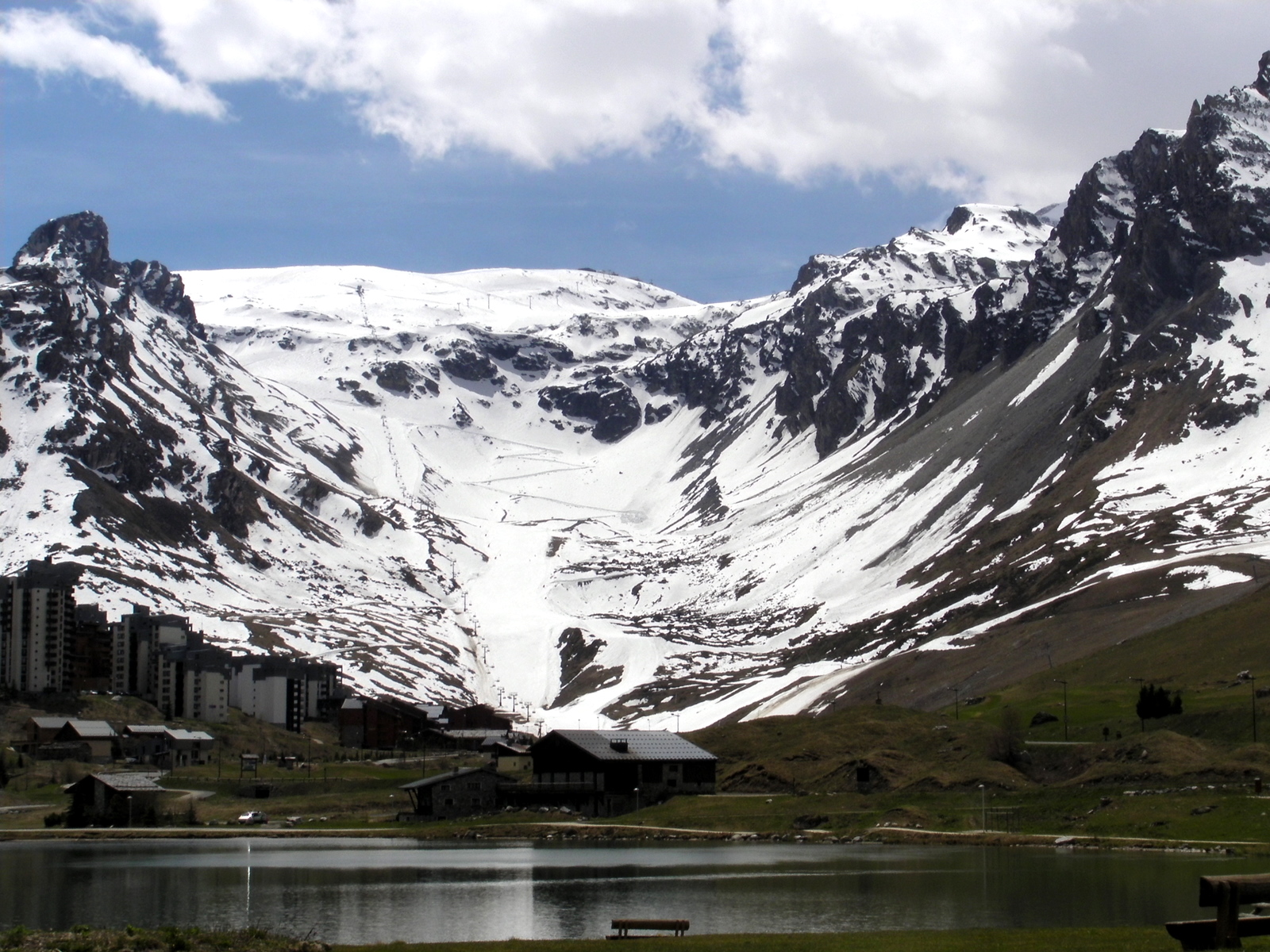
Going for a walk around the lac de Tignes the "vernal" plants were all out in their full glory - those are the first plants to push through once the snow clears off the surface. Here is a slide show below of some of the photos I took at the side of the lake. Christiane poses as a flower for a couple of shots. The lake was teaming with trout - some really big ones too - amazing to think that they can survive the winter below the ice that all the people are walking over.


The lifts are still open at Tignes - all of them in the main station area - though hardly anyone was actually skiing. Nearly all of the commerces were closed. We spotted one restaurant open in Val Claret and one one boulangerie in Le Lac - where we had lunch overlooking the lake.


Friday, May 6, 2011

Training Highs and Lows

Three days ago after a 50km ride in the cold and wet with the body feeling tired, it drained any remaining motivation to cycle clean out of my system. The weather has improved since then but getting back on the bike today took a lot of effort. Every ride has induced leg pain since being hit by a virus last month - even on relatively short workouts with the pain starting at around the 2hr mark and usually on climbs. Pain is not a great worry but it kind of wears you down mentally and affects your morale over time. The one rule however is to get back out there because the only way to get over this reasonably quickly is to train.


Some days you just feel like saying to the world "stop - let me off " and today was one of them. I imagined never pedalling on a bike ever again and just sitting down and eating in front of films and TV until I exploded - like Mr Creosote from Monty Python who blew up after eating "just one more mint". Anyway I set out on the bike with low expectations.  As often inexplicably happens in training the outcome was completely opposite from the expectations. I had a great ride bettering my personal best by over 5 minutes, no leg pains and loads of energy. Perhaps I'd been suffering from withdrawal symptoms from coming off the endorphins a bit too long. Nothing lifts your morale quicker than a successful workout. It must all be about endorphins and other hormones. It does raise the question though regarding the high incidence of depression and even suicide amongst top level athletes. Graeme Obree comes to mind - though thankfully he eventually realised he had a problem - highly recommend his autobiography "The Flying Scotsman" and the film was OK too - but not so graphic about his depression. While the benefit of the endorpins is clear when they are working for you it does make you wonder if there is likely to be a backlash when you can't train. It even makes you wonder if people become obsessed with training simply to keep the flood of endorphins going. On the other hand perhaps that's what nature intended - so that man "the pack animal" goes out and runs all day hunting prey.  It did occur to me that one of the attractions of competition events is that you find yourself in a pack. Perhaps this unleashes all the survival instincts inherent in the human race and that's why you perform so much better than in training. It also makes me wonder if this is why the "peloton" phenomenon in cycling has developed and why tactics and team work are so fascinating.

Obree's biography title is, unknown to most, a play on the name of the most famous racing bikes that used to be produced in Scotland called "The Flying Scot". I had a touring version "The Scot" handed down to me as a kid and at age 16 set off without telling anyone and cycled around the coast of Scotland on it. There was no planning I just stopped off in youth hostels until running out of cash and then sleeping under the trees and feeding off fruit and veg from fields along the way. Guess cycling was in my blood a long time ago.

Tuesday, May 3, 2011

Stormy Weather

Set out with the best of intentions today, but it was a day too soon after the 140km workout. The weather was a bit dramatic and the original plan to come over the hill (where the white cloud is hanging in the photo below) was swapped with a straight run home in the valley below.

Montgirod seen from Aime

I was cycling back from Frontenex at 50km from Aime where I'd left the old van in the garage. The weather was forecast to worsen later on so I was discouraged from climbing to higher altitude.


Meanwhile my van is awaiting its fate in the garage and it could be terminal! I'm planning on giving it a real Viking send off by floating it out into a lake a bit and setting it on fire. It's just not right that something that has shared your life so closely and faithfully for years should be dumped in a scrap yard. I'll paint a proper boat on the side of it first so that it looks the part. This van taught me that you can learn all the skills of a formula one driver in a bus and still live.


Sunday, May 1, 2011

Wacky Races

Interesting to read here in a French cycling magazine that the latest research shows that although heart attack and stroke risk is greater for sedentary people as their body weight strays further from ideal reference weight, this isn't the case for people who stay aerobically fit! You can be obese or anorexically thin but if you have good aerobic fitness your heart attack and stroke risk is exactly the same as for ideal reference weight. It's led to a new term - being "fat fit". I think that's me just now - still, all summer ahead to lose a whole bunch of kilos. I'm much more likely to go airborne over a cliff or get squashed under a truck anyway - no idea what the statistics are there. On a similar note I'm witnessing the unexpected fact that my max heart rate is not getting lower with age - once again this only happens with sedentary people though in training manuals this is not made clear. I remember about 20 years ago my max heart rate on a bike was 186bpm and it's now 185. It used to be 193bpm for running sprinting but the problem is that I'm now way too decrepit to sprint without risking detaching ligaments or something to that effect - so I can't check that one out too easily.

This year's "Wacky Races" have well and truly begun. It's quite common to overtake cars on your bicycle when descending on narrow Alpine roads. Yesterday when descending into Favèrges some idiot in a big family car obviously decided that he was being humiliated in that he could not pull away from me. Just at that point we started to enter a built up area with sleeping policemen on the road. On a bike it's not necessary to slow down for those obstacles because by taking your weight off the saddle you absorb the entire bump with your knees and hips and at 6.8kg the bike is so light that it is unaffected by the bumps After being almost overtaken on the first speed bump the driver decided that he could accelerate over the next one! Up until this moment I'd only ever seen flying cars in Hollywood films. He completely took off, all four wheels off the ground, then his spongy suspension on landing made his car squirm all over the place - almost going off the road. Even worse he didn't succeed in increasing the gap between us. Having been provided with excellent entertainment so far I wasn't about to back off. There was a clear and less steep section ahead so he pulled away out of sight but about a kilometre further on I caught up again as he was stuck behind another driver. Arriving at the centre of Favèrge I had the pleasure of passing him right before the main junction and with both of us then going in separate directions he couldn't pass me again.

Training Log:
Aime - Albertville - Col de Tamié - Favèreges - Ugine - Col de la Forclaz -Albertivlle - Aime. 140.43km, 2237m climbing. 5hrs 45mins, 7330 Calories. Weight 73kg. Weather: wind, sun, localised rain/wind storms.


The last cold virus is still having an effect even weeks later - coughing out stuff and not feeling right. When cycling there is no coughing but nasal breathing is still impossible so that shows to me my system has not fully recovered. The long valley roads to Albertville were head on into the wind as usual as it is towards the West and the adiabatic (mountain) winds are at their strongest mid afternoon. I'd left rather late - about 2:45pm because it had been cold overnight and was around 2°C in the morning. Better to let the air warm up with the sun even though storms were forecast for the afternoon. It was slightly chilly in just a shirt and shorts but most of the time on the outward leg of the ride the sun was out and unobstructed by either clouds or mountains. With the sun directly on the body you get warm quickly and it's better to put up with the chill in the brief shadow areas to avoid overheating in the sun. It does amaze me however how you can stay warm through effort wearing just a thin short sleeved shirt at 30 to 40 kph when everyone else is walking around in overcoats. For some reason - probably psychological - I don't push too hard against the wind. It's probably because it's so inefficient and you really tire yourself out - so it's best to save energy until you are out of the wind and then try to make up time by ramping up your speed. Today however, due to that late start and not finishing until about 8:30pm the mountain winds would start coming back down the valley in the evening and against me on the return leg too and so I'd have the mass of cold mountain air descending against me later on.

The climb up the Col de Tamié was fine and despite the head wind I was stronger and faster than five days previously - sprinting up the final few hundred meters at about 18kph and enjoying the effort. After that was the eventful descent into Favèrge racing the car, then the long cycle track descending pregressively towards Ugine. There was a strong sidewind on the cycle track but eventually as the route swung around to South of East it was possible to sustain around 40kph and gain some time back. I'd not be stopping anywhere for a break today because time was limited having started so late and also I wanted to simulate race conditions where you just don't stop. I was also trying out a new pair of gel padded cycling shorts and this would be a great test for them. My bum however had already started hurting at around the 50km mark. 15mm of padding directly over the bum bones is apparently still not enough at this stage. I'm not sure what is worse - bum pain or leg pain - but they are both pretty distracting. The good thing is that the bum stops hurting as soon as you get off the saddle and the legs recover from aches in about half an hour. I also notice that even when very tired if you focus on sustaining a strong effort especially when climbing then the pains mostly disappear. The worst pains are then when you stop this effort. I've no idea whether this is a psychological issue or a physical one.

Col de Tamié on the left, Albertville on the right.

Straight away on the climb up the Col de la Forclaz at around the 75km mark, the leg pain started. Obviously the legs didn't want my sore bum to be getting all the attention. When pain starts you know that it's there for the duration - it won't go away even if you stop and take a break it returns as soon as you put stress on the muscles. I was hydrating with a carbo/protein mix with all the minerals and B vitamins necessary for good absorption - but I think that proper carbohydrate pre-loading is necessary for even training at this distance. The only solution for dealing with pain is to slow down - but that just depends on how much pain you want to tolerate. I'm not bothered about the pain it's just a distraction so the slowing down only happens when I literally run out of steam. The Forclaz climb is very scenic and attractive - not steep at the beginning but quite steep for the final 3km. I was forced to drop down to 1st gear 34/28 to keep a good cadence on the steep parts - but only for short stretches. Pulling up on the pedals removes a lot of the strain of pushing down and likewise reduces the muscle pain considerably while adding anything up to 50% greater speed. The descent into Queige and on to Albertville was a welcome break from the climbing. At Albertville I knew that I was tired because I stopped being attentive and became disoriented at a junction not recognising where I was for a moment.

Col de la Forclaz - Ugine left, Queige right.

The wind had turned and was against me again when climbing back from Albertville to Moutiers. I took the road through Cevins because there is a public water tap there where you  can fill water bottles. So far in four and a half hours I'd only drunk one litre of sports drink - but that's all my thirst demanded. It wasn't a hot day. Now the sun had disappeared behind the hills and thunder clouds and it started to rain - but with still a considerable distance to go and tiredness setting in. Fortunately the rain was mainly slightly further to the West side of the valley over the mountains to the West so I was just catching the edge of it. I stopped briefly to put on an extra shirt which had been anticipated might be necessary when the sun went down and it did the job. There was no need for the water/wind proof jacket - which unless it's very cold or raining heavily has a negative effect of making you so wet with sweat that you are better of without it. Amazing that even in this weather  and with the sun down only a couple of tee shirts are necessary to stay warm. At this point I made myself eat a carbo/protein energy bar and  soon felt the benefit when the sugar got to the brain. Reaching the other side of Moutiers the roads were dry and clear for the rest of the return trip. Taking a deviation through Pomblières there is a short steep climb where surprisingly, with good pedalling technique, I could still keep up a fairly reasonable power output. For the 1.6km Tunnel du Saix I had mini superbright led lights both front and back, but as cars were now lit up all the time they stayed on for the rest of the way home - sunglasses now firmly slotted into the front vents of my helmet. Night was rapidly closing in and it was really nice to be home and to collapse in front of a good escapist movie with a hot drink. I went to bed with a copy of a biography of Stalin - which predictably put me to sleep in minutes.